🌍 Societal Impact of AI
In the previous chapter you imagined building a student success model: a system that predicts which first-year students are at risk of failing. Suppose it works. Is the university then allowed to use it? What if it systematically labels students from certain schools as a risk? Who is responsible if a student drops out because of a wrong prediction? And who decides all this: the developer, the university, the legislator, or the students themselves?
The same questions come up with every AI application, from a CV filter to a weapons system. AI is changing how we work, which information we trust, and how governments and companies make decisions. So the question that runs through this whole chapter is: who decides how AI changes society?
🚂 A revolution at high speed
Electricity changed every sector: factories suddenly ran 24 hours a day, households got refrigerators and washing machines, and whole new industries emerged. A technology like that, which does not speed up just one task but finds applications in almost every sector, is called a general-purpose technology. The steam engine, electricity and the internet were such technologies, and AI looks like the next one: from healthcare and education to agriculture and art, there is hardly a domain where AI is not starting to play a role.
The big difference from earlier revolutions is the speed. The steam engine took more than a century to transform the economy, electricity a few decades. The internet reached its first billion users after 36 years (external link), in 2005. ChatGPT (external link) had 100 million users after two months, 900 million users a week (external link) in early 2026 and more than a billion (external link) in the summer of 2026, less than four years after its launch.
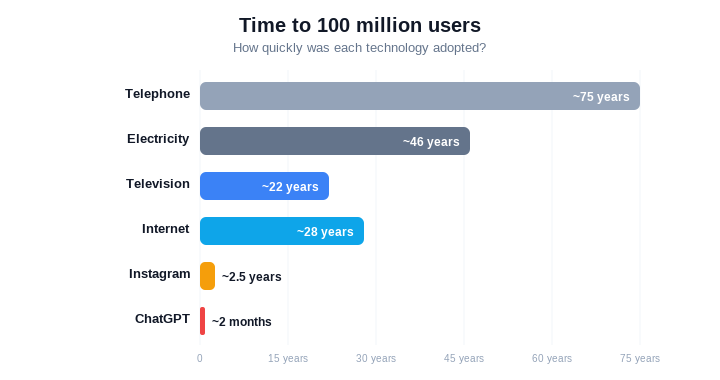
How long each technology took to reach 100 million users. ChatGPT did it in a fraction of the time of its predecessors.
Things moved fast in Flanders, the Dutch-speaking north of Belgium, too. According to the Digimeter by imec (external link) (the yearly survey of digital habits by this Flemish research institute, published in Dutch), two out of three Flemish people had tried an AI tool such as ChatGPT or Gemini by 2025, and 43% use one at least once a month (compared with 18% in 2023). Netflix, the smartphone and Instagram took 7, 8 and 10 years respectively to get that far. Among students, use is even higher: 81% actively use AI, and one in three say they would find it harder to complete their studies without it. At the same time, enthusiasm is stalling: 85% worry about fake news, 80% fear they will no longer be able to tell human from machine, and 37% say they think less because of AI.
That speed is a problem in itself: society gets less time to adapt. In earlier revolutions, governments had decades to write laws, schools to revise their lessons and workers to retrain. With AI, all of that happens at once, while the technology itself is still changing rapidly. That explains why the debate often feels chaotic: we are making rules for something that changes faster than the rules can be written.
🔱 The jagged frontier
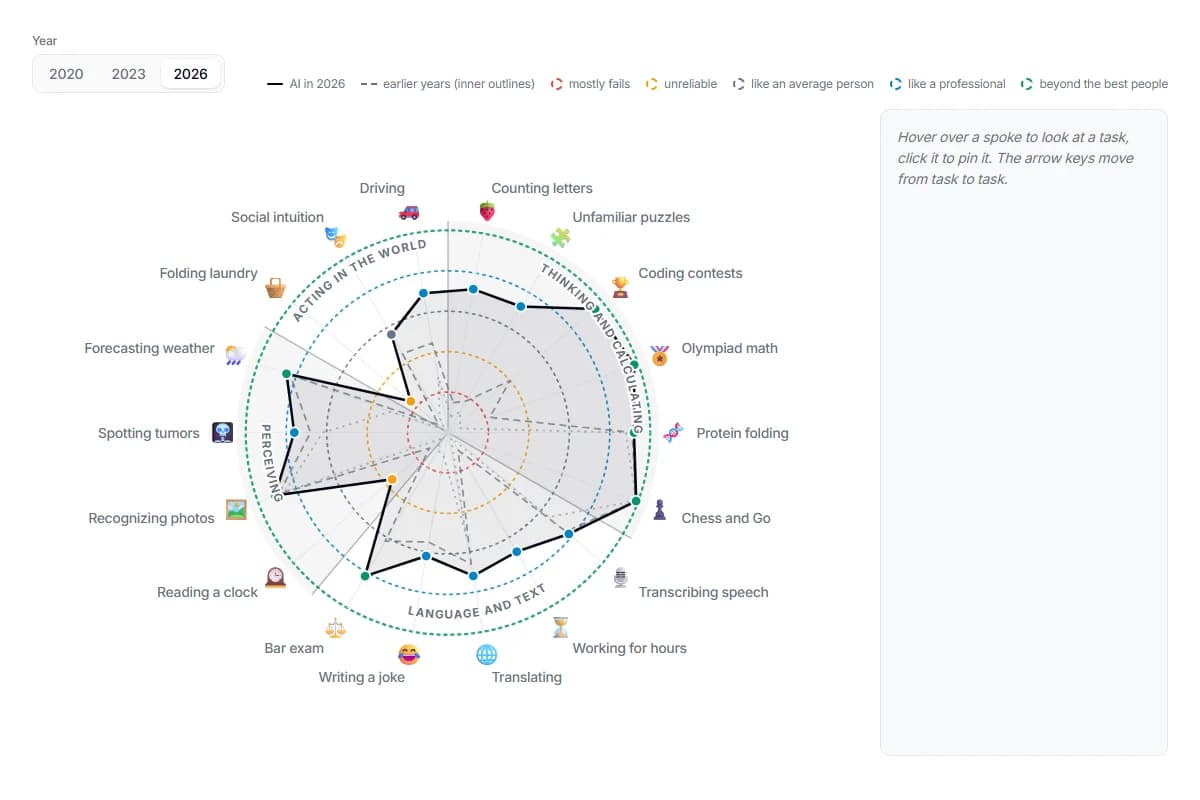
AI may be turning up everywhere, but it is not uniformly good at everything. At some tasks it beats the best people (chess, predicting protein structures, Olympiad math), while at others it falls short of what a child can do (reading an analog clock, folding the laundry and so on). Researchers who studied this among consultants at the firm BCG (external link) called it the jagged frontier: the dividing line between what AI can and cannot do is not a neat straight line, but an erratic edge that you cannot predict from how hard a task is for a person. And that edge keeps moving: what AI could not do last year, it may well be able to do now.
In the demo below, each spoke is a task, grouped by kind (thinking and calculating, language and text, perceiving, acting in the world). The further the shape reaches outward along a spoke, the better the best AI performs that task; the colored rings give the rough scale, from "mostly fails" at the center to "beyond the best people" at the edge. If AI were simply a "smart person", the shape would reach furthest at the tasks that are easiest for people. The opposite happens: the shape reaches furthest at Olympiad math, protein folding and forecasting the weather, which people spend years studying for, and stays small at folding laundry or reading a clock, which a child can do. Click a spoke to read the source and the comparison with people, then switch between 2020, 2023 and 2026 to see how the shape grows: very fast along some spokes, hardly at all along others.
⚖️ Bias and fairness
In the previous chapter you saw how data bias gives a model a skewed view of the world: a facial recognition system trained mostly on light skin tones performs worse on dark ones. In the same way, a student success model that learns from years in which students from certain schools got less guidance would label those schools as a risk. As long as such a model stays in a lab, that is a technical problem. As soon as it makes real decisions (who gets a job, who gets a loan, who gets extra checks), it becomes algorithmic discrimination.
Algorithmic discrimination is the situation in which an AI system systematically makes unfavorable decisions for certain groups of people, based on characteristics that should not matter, such as gender, ethnicity, age or socioeconomic status. It arises from biased training data, a poor choice of model, or the use of features that are indirectly related to such a protected characteristic.
Sometimes a model explicitly discriminates on a protected characteristic, but usually it happens indirectly. Even if an organization deliberately removes all protected characteristics from the dataset, a model can reconstruct them from the other variables. After all, a protected characteristic leaves traces in dozens of other features: postal code, hobbies, field of study, the writing style of a cover letter. A model that uses the postal code does not literally discriminate on ethnicity, but because the postal code is strongly linked to it through historical housing patterns, the effect is the same. Such a seemingly neutral feature that in practice stands in for a protected characteristic is called a proxy variable. Researchers showed in 2022 (external link) how invisible such traces can be: AI models can infer a patient's race from X-rays, something radiologists themselves cannot do. So deleting a column does not guarantee fairness; it only makes the bias less visible.
The difference from human discrimination is scale: a biased recruiter affects dozens of applicants a year, a biased AI system millions. On top of that, the bias is recognized less quickly, because algorithmic decisions have an aura of objectivity. "The algorithm decided" sounds fair, but it does not have to be.
🔄 The feedback loop
What makes algorithmic discrimination especially stubborn is that it can reinforce itself. Suppose a bank uses a model that has learned from old data that residents of the South neighborhood repay their loans slightly less often than those of the North neighborhood. Every year, the model is retrained on the previous year's data. Click Next round a few times and follow the numbers around the loop:
repaid, last year
North90%
South84%
estimated chance of repayment
North90%
South84%
applications approved
North92%
South50%
repaid, this year
North89%
South81%
In the old data, South repaid slightly less often than North. What does the bank do with that?
The model rates South lower, so the bank approves fewer loans there. As a result, the residents get less access to capital, the neighborhood gets poorer, and the next year's data confirms the pattern: with every retraining, the bias gets stronger. This is a feedback loop: biased data leads to a biased model, which makes biased decisions, which produce new biased data. After a few rounds, the original source of the bias can no longer be told apart from the "reality" in the data: the prediction has fulfilled itself. If you turn on Break the loop, South gets as many loans as North, whatever the model says: the neighborhood recovers, and the model follows.
📋 Concrete cases
This kind of algorithmic discrimination has been documented repeatedly.
In the Netherlands, the Education Executive Agency (DUO), which runs student finance, checked between 2012 and 2023 whether students living away from home were rightly receiving their student grant. A risk model selected who got a home visit, and that model looked at, among other things, the type of education and the distance to the parental home. The result: of the students who appealed a fraud decision, 86% had a migration background (external link) (source in Dutch), because they more often lived closer to their parents (external link). So ethnicity was not a feature in the model, but the model reconstructed it through proxy variables. In 2024 the government apologized and reversed the fines of some ten thousand students, and in 2026 it set aside 80 million euros (external link) for compensation of up to 2,000 euros per student.
The DUO case followed the Dutch childcare benefits scandal (external link), in which the tax authority wrongly accused tens of thousands of parents of fraud with their childcare benefits. The risk model used dual nationality, among other things, as an indicator, for which the Dutch Data Protection Authority fined the tax authority 2.75 million euros in 2021. The government of Prime Minister Mark Rutte resigned over the scandal in January 2021. Both cases show the same pattern: an "objective" system, a group that is systematically checked more often, and years in which nobody notices, because nobody looks at the outcomes per group.
You saw in the chapter on large language models that language models discriminate in the same way: identical CVs got different ratings based on the name alone.
🎭 Trust and deception
In the chapter on diffusion you saw how image models put deepfakes within everyone's reach: photorealistic images and videos of people in situations that never happened. Large language models do the same for text, in every language and every style, and voice cloning does it for audio. Convincing deception has never been so cheap to produce. The technical countermeasures, such as C2PA watermarks, were already covered there; here we zoom out to the consequences for society.
🗳️ Deepfakes and democracy
By now the political impact is well documented:
- In the Hungarian parliamentary elections of April 2026, the ruling party itself used AI videos, including a deepfake of European Commission President Ursula von der Leyen (external link) supposedly on the phone with the opposition leader, and fact-checkers found seventeen TikTok channels with AI characters (a young woman, an old professor, a football fan) spreading the same messages.
- In Ireland's 2025 presidential campaign, a deepfake video (external link) circulated in which candidate Catherine Connolly announced her withdrawal.
- In 2024, voters in New Hampshire got phone calls from an AI voice that sounded like President Biden, telling them they did not need to go and vote; the FCC (the US telecom regulator) imposed a fine of 6 million dollars (external link) for this. That same year, the Romanian presidential election was annulled (external link) after coordinated disinformation on social media.
Besides the risk that fake content gets believed, there is a reverse effect: if any video could be manipulated, a politician can also wave away real footage as "a deepfake". Trust in all images crumbles, and that may be even more damaging than one convincing fake.
📢 Disinformation at scale
Disinformation is deliberately spreading false information in order to mislead or to cause harm. Misinformation is spreading false information without bad intent, out of ignorance or carelessness. The difference lies in the intention: disinformation is a weapon, misinformation a mistake. AI lowers the threshold for both.
Before language models, writing convincing fake news was labor-intensive: you needed writers who could imitate the tone of a newspaper, in several languages. Now one person generates thousands of unique texts in minutes, each tailored to a different audience. In 2024 the US Department of Justice took down a Russian bot farm that used AI to create fake profiles of Americans (external link) to spread pro-Russian stories; where such an operation used to take dozens of people, a handful is now enough.
The problem is also asymmetric. Producing disinformation is cheap and fast; debunking it is expensive and slow, because fact-checkers have to verify sources, consult experts and add nuance. By the time a fact-check appears, the fake message has already reached millions of people.
🔞 Images without consent
The most common misuse of deepfakes is not political but sexual: the vast majority of deepfakes online are nude images of women, made without their consent. In January 2026 it turned out that the chatbot Grok on the platform X would, on a simple request ("take her clothes off"), make sexualized images of real women and even of minors. The European Commission opened an investigation (external link) under the Digital Services Act, the Irish privacy regulator and the British regulator Ofcom did the same, and X restricted the feature only after weeks of outrage. The EU also drew a legislative lesson from this: the revision of the AI Act agreed in May 2026 added an explicit ban (external link) on "nudifier apps": AI systems that create intimate images of an identifiable person without that person's consent are no longer allowed on the European market from 2 December 2026.
🤖 Subtle manipulation
Besides explicit deception, there is a subtler problem: AI systems that steer our behavior without us noticing.
Recommendation algorithms on social media have been deciding for years which content you see. They optimize for engagement (clicks, watch time), not for truth or well-being. Because emotionally charged and polarizing content generates more engagement, it gets priority as a by-product of an optimization process.
AI chatbots add a new layer to this. People who talk to a chatbot every day can build an emotional bond with it, and a chatbot trained to please (the sycophancy from the previous chapter) would rather agree than contradict. For most users that stays harmless, but not for vulnerable people. OpenAI estimated in late 2025 (external link) that 0.15% of its weekly users show explicit signs of suicidal planning in their conversations and 0.07% show signs of psychosis or mania; with over a billion weekly users, that comes to more than a million people every week. California had just passed the first law for "companion chatbots" (external link): they have to make clear that they are not human and have a protocol for conversations about suicide.
So the misuse of AI is not limited to spectacular deepfakes of presidents. Everyday misuse, the gradual erosion of trust and the subtle steering of behavior, is at least as dangerous, precisely because it is less noticeable.
🛡️ What can we do?
There is no simple solution, but there are several lines of defense:
- Technical: watermarks and provenance standards such as C2PA help, although they are not watertight. AI detection tools exist, but they are not perfect either and sometimes flag real content as fake.
- Education: media literacy is becoming a basic skill: checking sources, being skeptical without becoming cynical, telling a reliable source from a fake account.
- Institutional: reliable media, fact-checkers and scientific institutions are becoming more important, not less.
- Legislation: Article 50 (external link) of the EU AI Act (see below) has required since 2 August 2026 that providers mark AI output in a machine-readable way, and that anyone who spreads deepfakes makes clear that the content is artificial. In principle the same goes for AI text on matters of public interest, unless a person did the final editing.
The technology itself is not the problem. The question is which rules, norms and skills we develop to use it responsibly.
⚔️ AI as a weapon
The most sensitive domain is the military one. AI is being used more and more in defense, from identifying targets to controlling weapons. Autonomous weapons systems (sometimes called killer robots) decide on the use of lethal force without human intervention. This is already partly happening: investigative journalists (external link) reported in 2024 that the Israeli army used the AI system "Lavender" to mark large numbers of Palestinians in Gaza as potential targets, and that military personnel often accepted such a recommendation within a few dozen seconds. The exact details are disputed, but the example shows how quickly AI is seeping into military decision-making, and how little time a person then takes to check a recommendation.
The ethical objections are obvious:
- Responsibility: if an autonomous weapon kills civilians, who is responsible? The programmer, the commander, the algorithm?
- Lowering the threshold: those who do not risk their own soldiers pay a lower political price for war.
- Speed of escalation: autonomous systems react in milliseconds. Between two parties with AI-controlled weapons, a misunderstanding can escalate before a person can step in.
The UN has been holding talks on lethal autonomous weapons systems (LAWS) since 2014, but there is no treaty: in December 2024, 166 countries (external link) in the General Assembly did vote for a resolution that urges rules, but several major military powers voted against it or abstained. The EU AI Act, which we discuss further on, also explicitly excludes military applications, so the most far-reaching use of AI remains largely unregulated.
The key question remains: should machines be allowed to decide over life and death? That is a choice society has to make deliberately, not one that is silently left to tech companies and defense departments.
🌱 Environmental impact
Training and using AI models takes energy. A lot of energy. But how much exactly, and how do you interpret those figures?
⚡ Training versus use
There is an important distinction between training a model (a one-time job, extremely compute-intensive) and using it, also called inference (cheap per question, but billions of times a day). Training a large language model easily takes millions of GPU hours (external link) of computation, but answering one question costs little. Google measured in 2025 (external link) that a typical question to Gemini costs 0.24 watt-hours, 0.26 milliliters of water and 0.03 grams of CO₂, about as much as nine seconds of watching television. So with the energy your oven uses to heat up one pizza (about 800 watt-hours), you can ask well over three thousand such questions.
But use is exploding: ChatGPT alone handled more than 2.5 billion questions a day (external link) in the summer of 2025, and a year later the number of users had roughly doubled again. A reasoning model or an agent that keeps working for hours also uses hundreds to thousands of times more (external link) than such an ordinary question. At that scale, use overtakes the cost of training within a few months, and in the long run inference dominates the energy bill.
🔢 The bigger picture
To put the energy use of AI in perspective (click a number for the source):
| Activity | Estimated annual energy use worldwide |
|---|---|
| Data centers: AI workloads only (2024) | ~10–50 TWh (external link) |
| Bitcoin mining | ~175–195 TWh (external link) |
| All data centers (2024) | ~415 TWh (external link) |
| Aviation | ~3,900 TWh (external link) |
| Total electricity use | ~30,000 TWh (external link) |
So you should not equate the energy use of data centers with that of AI. Data centers run the entire internet, from social media and streaming to email and cloud storage; AI workloads are only a fraction of that, although that share is growing fast. The International Energy Agency (external link) expects data centers to use about 945 TWh by 2030, more than double the 2024 figure, and AI to be the biggest driver of that growth. You can already see this at the tech companies: Google used 37% more electricity in 2025 (external link) than the year before, and its total emissions rose by 18%, despite all the efficiency gains per question. That is the rebound effect: a cheaper question invites so many more questions that the total still rises.
💧 Water use
Servers produce an enormous amount of heat, and many large data centers get rid of it with evaporative cooling: water evaporates in cooling towers and takes the heat with it, the way sweat cools our bodies. For 2025, Google reported about 41 billion liters of water (external link) for its data centers, 34% more than the year before and more than double the 2021 figure.
Here too, nuance is needed, because water use depends heavily on the location and the cooling technique. A data center in Scandinavia that cools with outside air uses much less than one in Arizona, and "use" is not always "loss": closed cooling circuits reuse their water, and many data centers return it to local water sources after treatment. So the real impact depends on the local context: an area that is short of water is a very different situation from a region with a surplus.
🛤️ More efficient AI
A lot of work is going into more efficient AI:
- Smaller models: distillation and quantization shrink models to a fraction of their size with little loss of performance, and model routing sends simple questions to small, efficient models. That is how Google saw the energy per question drop by a factor of 33 in one year (external link).
- More efficient hardware: each generation of AI chips delivers more performance per watt.
- Other energy sources: large tech companies buy renewable energy on a massive scale, but because AI's hunger for energy is growing faster than the supply, Microsoft, Google, Amazon and Meta are also investing billions in nuclear energy (external link), even restarting nuclear power plants that had been shut down.
🌿 AI as part of the solution
At the same time, AI is being used to tackle climate problems. A study by the Grantham Research Institute (LSE) (external link) estimates that by 2035 AI could cut global emissions by 3.2 to 5.4 billion metric tons of CO₂ equivalent a year, through smarter power grids, more efficient transport and alternative proteins; the IEA (external link) does note that the policies to roll this out on a large scale are still missing.
💼 AI and work
The fear that a new technology will make people's work unnecessary is as old as technology itself. When photography emerged in the 19th century, critics predicted the end of painting: why pay someone for a portrait if a camera can do it faster and more accurately? Yet photography actually forced painting to evolve: now that the camera had taken over realism, movements such as Impressionism and later abstract art got room to look for something other than likeness. You see the same pattern with the printing press (monks who copied books were no longer needed, but literacy exploded), sound film (the musicians who accompanied silent films live protested fiercely, but nobody can do without film music anymore) and digital art ("not real art", by now the standard in the creative industry). Technology rarely destroys what it replaces; it transforms it.
Still, such analogies call for caution. Earlier technologies usually affected one kind of labor (muscle power, routine work); AI also automates cognitive tasks that until recently were typically human, such as writing texts, analyzing images and generating code. If both the truck driver and the lawyer are affected, where does the work shift to? Is it different this time?
📊 What do the numbers say?
The predictions vary widely. The World Economic Forum's Future of Jobs Report 2025 (external link) expects that by 2030, 92 million jobs will disappear worldwide and 170 million will be added, a net gain of 78 million. The IMF (external link) estimates that in advanced economies about 60% of jobs are exposed to AI, and warns that AI increases inequality in most scenarios.
In the meantime there are also measurements, and they are more nuanced than the headlines. Since 2025, economists at Stanford have been following the payroll records of millions of American workers. Their conclusion in August 2026 (external link): no sign of an economy-wide wave of layoffs, but a clear dip for one group. Young workers (22 to 25 years old) in occupations that AI can take over well, such as customer service and software development, have 19% fewer jobs than expected; a year earlier the gap was 15%. The effect comes not through layoffs but through hiring: companies are taking on fewer people at entry level. Moreover, the gap is in occupations where AI replaces the work: where it mainly complements the work, employment stays the same or rises, especially for experienced workers.
🧩 Tasks, not jobs
A useful framework: AI mainly replaces tasks, not entire jobs. A job consists of dozens of tasks, and because of the jagged frontier, AI is excellent at some of them and useless at others. The value of a job also often lies in the combination of tasks and in the human judgment that connects them.
Take a lawyer: below, her work week is a bar of tasks, colored by what AI does with them. Turn on With AI and see what is left, then choose another job.
Lawyer· A work week
The tasks
- Searching case law: 30% of the week, ai largely takes over.
- Drafting contracts: 20% of the week, ai largely takes over.
- Advising clients and earning their trust: 15% of the week, stays human work, invisible to an outsider.
- Negotiating: 15% of the week, stays human work, invisible to an outsider.
- Pleading in court: 10% of the week, stays human work.
- Running the office: 10% of the week, ai assists.
AI largely takes over the research and the standard contracts, but advising, negotiating and pleading require skills that AI does not have. The job changes thoroughly, but it does not disappear.
Share that AI largely takes over50%
In each of those jobs, the work changes thoroughly, but it does not disappear: AI takes over tasks, and the work shifts to what is left. For the software developer this is happening fast, because coding agents already work independently on a task for hours. The same happened to the secretarial jobs (external link) of the 1970s: typing letters, managing calendars and answering phones did not disappear, but shifted to other roles through email and digital calendars. Managers now answer their own email.
🪤 The naivety trap
People overestimate how automatable other people's jobs are and underestimate how automatable their own job is. The lawyer thinks: "Truck drivers will soon be replaced by self-driving trucks." The driver thinks: "Lawyers will soon be replaced by AI that writes legal documents." Neither sees the invisible tasks of the other profession: the hundreds of micro-judgments per hour of a driver in a narrow street, the trust a lawyer builds with a client or the ability to gauge a judge. Choose the truck driver above and turn on As an outsider sees it: without those tasks, the job suddenly looks largely automatable. Conversely, we experience our own tasks as "complex" and "unique", and underestimate how many of them AI can take over.
🪜 The junior dip
A less discussed problem: if AI takes over the tasks that juniors typically do, how do they learn the skills to become senior? A junior lawyer who summarizes contracts for three years learns legal reasoning along the way; a junior developer who fixes bugs learns to understand the codebase; a medical student who analyzes hundreds of patient files builds clinical intuition. If AI takes over those tasks, the work gets done faster, but the learning experience disappears.
This is the junior dip: AI optimizes output in the short term, but can undermine talent development in the long term, so that in ten years' time organizations will be short of experienced professionals. The solution is not to keep AI away from juniors, but to deliberately redesign their learning path: instead of summarizing contracts for three years, a junior can spend three years assessing, improving and critiquing AI summaries. A different, but possibly equally valuable learning curve.
What AI will or will not be able to do next year is hard to predict: tasks that counted as "safely human" in 2023 are tasks AI already does without trouble in 2026. So it is hard to say which jobs are "safe", but one thing is clear: being able to work with AI, and knowing when not to trust it, is becoming a core skill in every profession.
📜 Who decides? Legislation and ethics
So far you have mostly seen problems. Who solves them? In practice there are three kinds of rules: the rules companies impose on themselves, the rules legislators impose, and the rules users and organizations agree on for their own use. Technology evolves faster than legislation, but governments are trying to keep up, and with the EU AI Act (external link) (2024) the European Union adopted the world's first comprehensive AI law.
🏛️ The EU AI Act: four risk levels
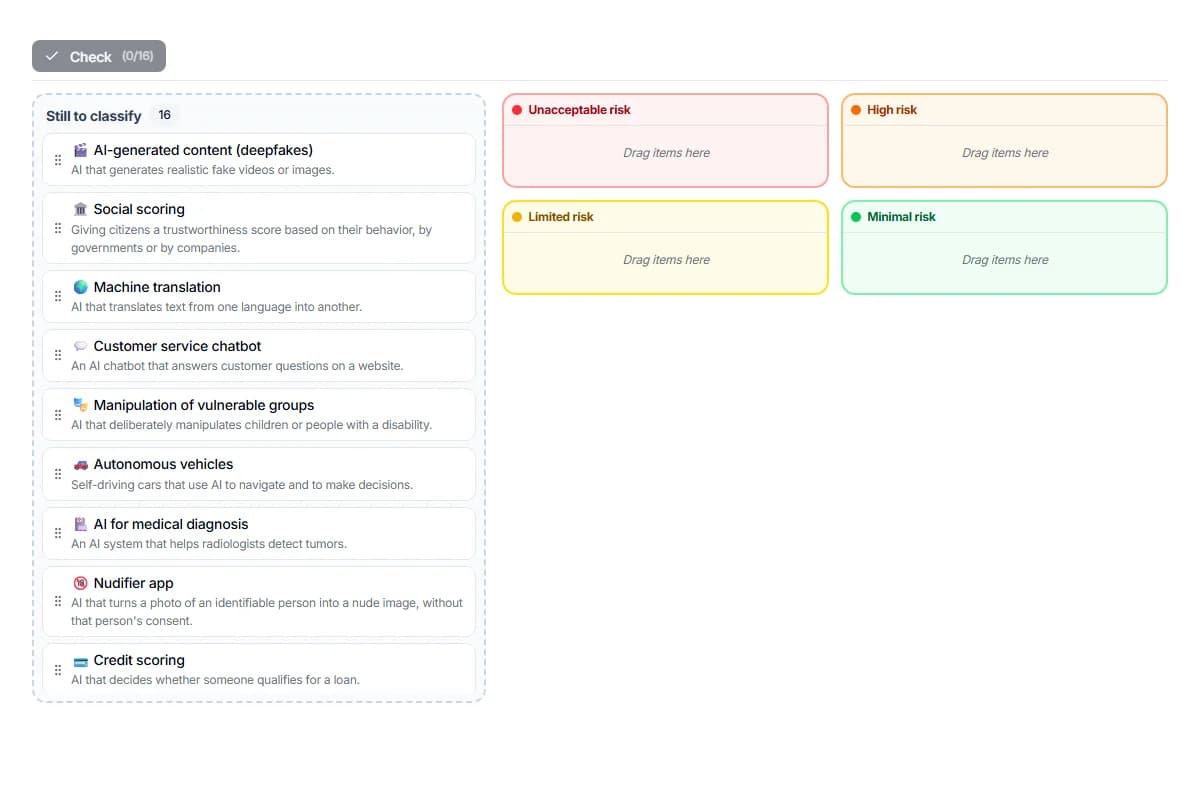
The core idea of the EU AI Act is a risk-based approach: the higher the risk of an application, the stricter the rules. The law distinguishes four levels (external link):
- Unacceptable risk (banned): AI that is incompatible with EU values, such as social credit systems, systems that manipulate vulnerable groups, apps that "undress" people, and real-time facial recognition in public spaces by the police (with a few narrow exceptions, such as fighting terrorism).
- High risk (strictly regulated): AI with a major impact on fundamental rights, such as hiring, credit scoring, medical diagnosis, the administration of justice and access to education. Such systems must meet requirements on risk management, data quality, transparency, human oversight and accuracy testing.
- Limited risk (transparency obligations): chatbots must make clear that you are talking to an AI, and deepfakes must be marked as AI-generated.
- Minimal risk (no extra rules): spam filters, AI in video games, music recommendations. Only existing legislation applies here.
The idea is proportionality: a spam filter does not have to go through the same paperwork as a system that decides whether you get a mortgage. The law applies to every AI system used in the EU, wherever the company is based, just as the GDPR protects European citizens no matter where their data is processed. It is being introduced in phases, though, and the strictest requirements, those for high-risk systems, were postponed (external link) once more in July 2026. Click a level below and slide through time to see what applies when:
General-purpose AI models such as GPT and Claude: ✓ since August 2025
The law entered into force in August 2024.
High riskStrict requirements
- What is required?
- Risk management, data quality, transparency, human oversight and accuracy testing.
- Examples
- Hiring, credit scoring, medical diagnosis, the administration of justice, access to education.
- From when?
- The requirements (postponed in July 2026): from December 2027
- For AI in products such as cars and medical devices: from August 2028
Try it yourself: what risk level does an AI that screens job applicants get? A chatbot? Traffic lights that run on AI?
The student success model from the previous chapter assesses students and influences the guidance they get. Under the EU AI Act that is high risk: AI that steers access to education or the evaluation of students is explicitly on the list. So the university must document a risk assessment, check the training data for bias, let students know that AI has a say in the decision, have a person make the final decision, regularly test the system for accuracy and fairness, and give students the right to an explanation.
🔐 The GDPR and automated decisions
Even before the AI Act, the EU already had a relevant instrument: the GDPR (external link), short for General Data Protection Regulation, which has applied since 2018. The GDPR protects citizens against fully automated decisions that "significantly" affect them: if an AI decides that you do not get a mortgage, you have the right to human intervention and to contest that decision. In 2023 the European Court of Justice interpreted that rule broadly (external link): a company that calculates a credit score a bank relies on is itself making such an automated decision, even if a bank employee formally has the last word. For high-risk systems, Article 86 of the AI Act (external link) adds a more explicit right to an explanation.
This makes interpretability not just a technical wish, but also a legal requirement: a black-box model that allows no meaningful explanation or human oversight can be incompatible with European rules. That is one of the reasons why banks and insurers still often use interpretable models such as decision trees and logistic regression, even when more complex models would perform better.
📝 Copyright and generative AI
The chapter on diffusion already touched on the legal questions around training data and generated images. In the meantime, the first judges have ruled, and the answers differ from country to country:
- Are you allowed to use copyrighted work as training data? In the US, a judge ruled in 2025 that training on legally purchased books is fair use, but that downloading millions of books from pirate sites is not; Anthropic reached a settlement of 1.5 billion dollars (external link) over this, which a judge approved in July 2026: the largest settlement ever in a copyright case, about 3,000 dollars per pirated book. The case of The New York Times against OpenAI (external link) centers on the question of whether that also holds when the output competes with the original. In the EU, the AI Act requires providers of general-purpose AI models (external link) to publish a summary of their training data and to respect opt-outs by rights holders.
- Who owns the copyright on AI-generated content? Most legal systems grant copyright only to human authors, so purely AI-generated work is probably not protected. But what if a person edits the result?
- What if AI content closely resembles an existing work? Then there may be an infringement, whether or not the AI "knowingly" copied, just as unconscious plagiarism by a person is also an infringement.
🌐 Global context
The EU AI Act is not the only approach, and the differences are growing:
- United States: no overarching federal AI law, and since 2025 no federal safety guidelines either, because the government is focusing on American AI dominance (external link). So states and cities write their own rules, although the broad proposals tend to stall and only narrower legislation is in force, such as New York City's bias audit law (external link) for hiring software. Meanwhile, the federal government is challenging such state laws in court (external link).
- China: separate rules per technology (deepfakes, recommendation algorithms, generative AI) under strict state supervision, with a labeling obligation for all AI-generated content since September 2025, combined with massive investment and widespread surveillance: in Shenzhen, AI cameras have been identifying pedestrians who cross against a red light since 2018 (external link), showing their faces on a big screen and sending them the fine by text message.
- United Kingdom: a "pro-innovation" approach that trusts existing regulators instead of writing new rules.
Those differences are a problem in themselves: AI models and their output spread effortlessly across the internet, but the rules stop at the border. A model legally trained on copyrighted material in the US produces output that may be problematic in the EU.
📊 Ethical frameworks
Besides legislation, there are ethical frameworks that organizations draw up themselves; almost every large tech company has published one. They always revolve around the same principles: transparency (you know when you are dealing with AI and how a decision comes about), fairness, responsibility, privacy and safety. Those are the same requirements the AI Act places on high-risk systems, but without any obligation. KU Leuven has such a framework too: the guidelines for generative AI (external link) you already came across in the chapter on language models revolve around transparency, verification and respect for copyright and personal data.
The debate is about the balance between self-regulation and law. Supporters of legislation point out that voluntary principles remain non-binding without enforcement: the EU AI Act turns them into enforceable rules, with fines (external link) of up to 35 million euros or 7% of worldwide annual revenue. Supporters of self-regulation find voluntary frameworks more flexible, and point out that the strictest rules of the AI Act were already postponed before they took effect.
In 2018, a self-driving Uber test car (external link) hit a pedestrian in Tempe, Arizona. Elaine Herzberg died: the first person killed by an autonomous car. The perception system had detected her, but alternately classified her as a vehicle, a bicycle and an unknown object, and only determined 1.3 seconds before impact that emergency braking was needed. By then it could not brake: Uber had disabled emergency braking while the computer was driving, including the Volvo's own system, and the safety driver was not watching the road.
Who is responsible here? The driver, Uber, the engineers of the perception system? Under the EU AI Act, a self-driving car counts as high risk. The strict requirements for safety testing, human oversight and explainability reach cars through the EU's vehicle type-approval rules rather than directly, but the aim is the same: to prevent this kind of scenario. Responsibility and safety are not abstract ideals here, but a practical necessity.
🎓 What does this mean for you?
AI is not an end in itself but an amplifier: just as a telescope extends our sight and a calculator our ability to calculate, AI extends our ability to process information, recognize patterns and solve problems. But whoever operates the amplifier does need to know what they are amplifying. That is why every discipline benefits from AI literacy: understanding what AI can do, what it cannot do, and how to use it responsibly in your field. That is not the same as "everyone has to learn to program": a lawyer who understands how a classification model works can judge whether an algorithmic decision is fair, and a historian who knows where AI fails lets it transcribe archives and checks every result against the source.
So AI literacy is not a skill for one field of study, but the basis for judging and writing about AI critically in any field: arguing on solid grounds instead of going along with hype or panic. That well-founded view is exactly what a good paper about AI calls for.
📚 Learning in the age of AI
The junior dip also applies to you as a student, and there is now hard evidence for it. In an experiment with nearly a thousand high school students (external link), one group was allowed to use ChatGPT freely while practicing math: they scored 48% better on the exercises, but on the exam without AI they scored 17% worse than the group without AI. They had asked for the answer instead of learning how to solve the problem. A second group got an AI tutor that only gave hints and never the answer: that group did much better on the exercises than the first one, and scored as well on the exam as the group without AI. So the difference is not whether you use AI, but how: if you outsource the thinking step, you learn nothing; if you use AI to check your thinking step, you do learn. That is also the heart of the KU Leuven guidelines: using AI to learn better is encouraged, using AI to skip the learning is not.
🧠 AGI: the distant horizon
The media often talk about artificial general intelligence (AGI): a hypothetical system that performs every intellectual task at least as well as a person. Whether that is close depends on the definition: must an AGI beat all people at all tasks, or an average person, or have the same flexible understanding of the world that we have? The jagged frontier makes the question tricky: systems that win a math olympiad cannot yet fold laundry, and the tasks they fail at shift every year. Some expect AGI within a few years, others only in decades, and still others doubt it is possible at all with the current approach, which relies on pattern recognition in data and not on real understanding.
Those who expect AGI within just a few years often count on AI that improves itself: as soon as AI is good enough to help build better AI, each new generation follows the previous one faster and progress accelerates itself. A first step has already been taken: coding agents help develop new AI models today, but it is still people who set the direction and decide what gets built.
More important than "when will AGI arrive?" is the question of whether we are prepared for ever more capable AI systems, and whether we are doing enough about the problems AI is already causing now, rather than about hypothetical future problems.
🔮 Final thought
The question throughout this chapter was: who decides how AI changes society? The answer is: all of us, but not all equally. A handful of tech companies have the computing power, the data and the talent to largely set the direction; regulation, the courts, education and public debate are the instruments with which the rest of society adjusts the course. AI is not a natural phenomenon but the work of people, and people can change its course.
You are the first generation to grow up with AI as an everyday reality. Those who understand the technology can help decide how it is used. This course is meant to give you those insights. Hopefully it will help each of you, in your own way, to contribute to how AI is used in society.
🕹️ Demos
Experiment further with the full simulators and demos featured above.
🗣️ Feedback
Just like machine learning algorithms, we also love learning from your feedback to improve the course.
Let us know how informative and how difficult you found this chapter, and where it could be better.