🗺️ Dimensions of AI
🧭 AI system dimensions
As you saw in the previous chapter, AI is a broad field with many kinds of techniques. To find your way, you ask the same five questions about every AI system, one per dimension:
- 🖼️ Modality: what kind of data does it process? Text, images, sound, tables...
- 🧠 Way of thinking: does it follow rules that somebody wrote down (reasoning), or does it find patterns in examples by itself (learning)?
- 🔁 Form of feedback: what does it learn from? From examples with the answer attached, without an answer, or from rewards?
- 🏫 Mechanism: which approach sits underneath? Rules, neurons, similarities, probabilities or evolution?
- 🎯 Purpose: does it judge existing data (analytical), or does it make something new (generative)?
Pick a system below and see which answers change. All the terms come up further on.
Input
Spam filter
Finds patterns in examples by itself.
Thousands of emails that someone marked "spam" or "not spam".
Output
🖼️ Modality: which type of data?
What kind of data goes into an AI system, and what comes out? That type of data is called the modality: 📊 tables, 📝 text, 🖼️ images or 🔊 sound. The most powerful systems today are multimodal: they combine several, so you can give ChatGPT a photo of your fridge and ask it in words for a recipe to go with it.
A computer only calculates with numbers, so every modality first becomes a series of numbers. Pick a modality below and see how the computer sees it:
What you see
click to change
What the computer sees
- 1bread roll
- 1soup
- 0fruit
- 1yogurt
One number per column: 1 if it is on the tray, 0 if it is not.
Try it out: for each modality, click 🔀 Different order. For text, images and sound the numbers stay the same, but what they mean changes: there the meaning lies in the order, or in the place in the grid. For a table nothing changes, as long as every number stays with its column. Because the structure differs so much, different techniques work best for each modality, such as language models for text and image models for photos.
🧠 Way of thinking: reasoning vs learning
🤔 Two systems of thinking
The psychologist and Nobel laureate Daniel Kahneman (external link) describes in his book Thinking, Fast and Slow (external link) two systems of thinking in your head. First try this little puzzle yourself:
A bread roll and an apple cost €1.10 in total. The roll costs €1 more than the apple. How much does the apple cost?
Answer as fast as you can.
- System 1 is fast and intuitive: it recognizes a face in a crowd at once, or catches a ball. It sometimes gets things wrong, and afterwards you can hardly explain how it reached its judgment.
- System 2 is slow and precise: it calculates step by step, as with 17 × 24 or when you check the puzzle.
You see the same division in AI. Learning algorithms behave like System 1: they recognize patterns in images, speech or text in a flash, but often cannot explain how. They work as a "black box": you see what goes in and what comes out, but not why. Reasoning algorithms are more like System 2: they follow rules step by step, are slower and less flexible, but can justify every step.
💭 Reasoning algorithms
With automated reasoning a machine reaches a conclusion by combining knowledge that somebody put into it beforehand. For that it needs knowledge, such as "all humans are mortal" and "Socrates is a human", and an inference algorithm that derives from them that Socrates is mortal, for instance with logic. That is how inference algorithms work out the best timetable, the most likely illness given a few symptoms, or the fastest route to your destination.
Their great advantage: they are explainable, because they can show every step of their reasoning, and they do exactly what the rules say.
So a self-driving car does not have to learn from thousands of hours of camera footage that it must stop for a red light: you are better off laying that down in a rule, If traffic light red → stop.
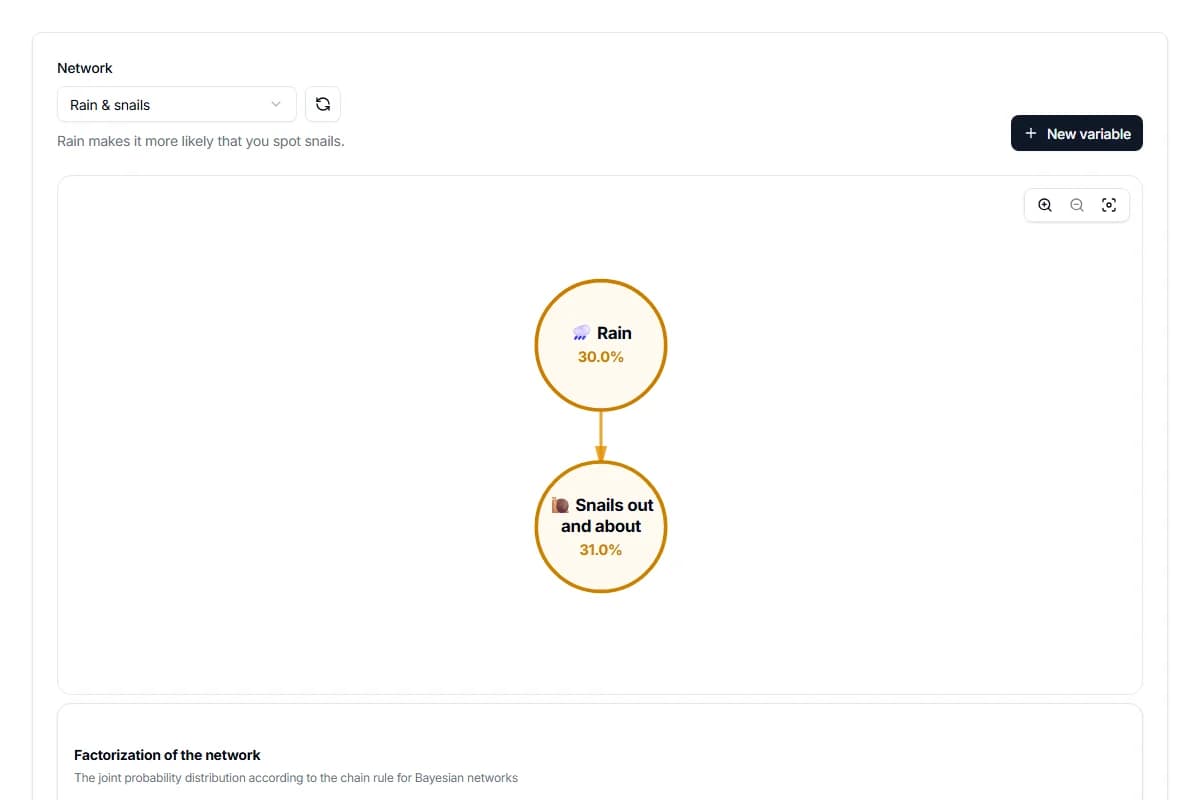
A medical expert system works the same way: a doctor writes down her knowledge as rules, such as fever and sore throat → flu (55%) or throat infection (30%) and white spots in the throat → throat infection (95%), and with every diagnosis the system can show which rules led to it. A Bayesian network works out such probabilities neatly. Hover over the symptoms with your mouse, and below, set fever and sore throat to ✅ and muscle ache and white spots to ❌: you arrive at the same 55% and 30%.
🏋️ Learning algorithms
With machine learning nobody writes down the rules: the system gets a great many examples and finds the patterns in them by itself. A few messy or even wrong examples do not ruin the whole thing.
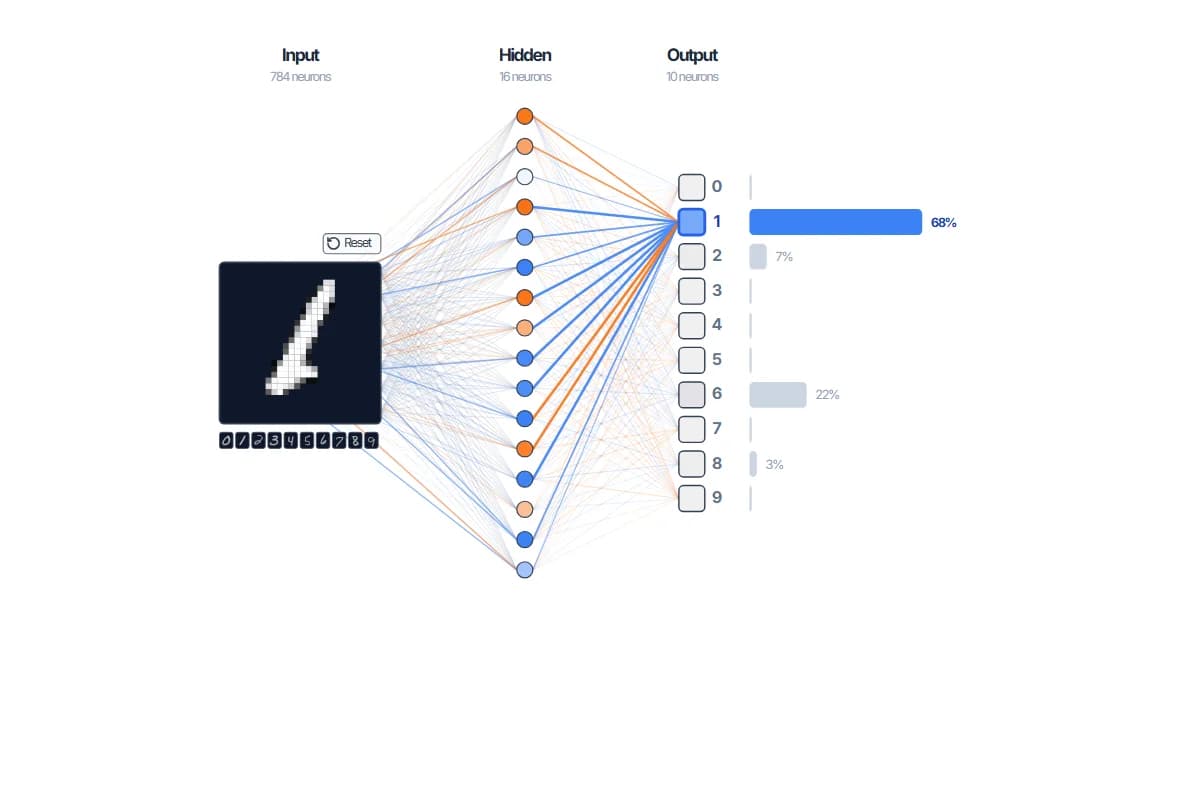
The neural network below learned to recognize handwritten digits this way, from thousands of examples with the right digit attached (the MNIST dataset (external link)). Click Reset, draw a digit and see on the right which digit the network recognizes.
The network picked up by itself what to pay attention to (curves, lines, corners). It combines so many clues at once that it cannot explain why a loop is a "2", and you could never write such rules about pixels down yourself either.
⚖️ When do you use which?
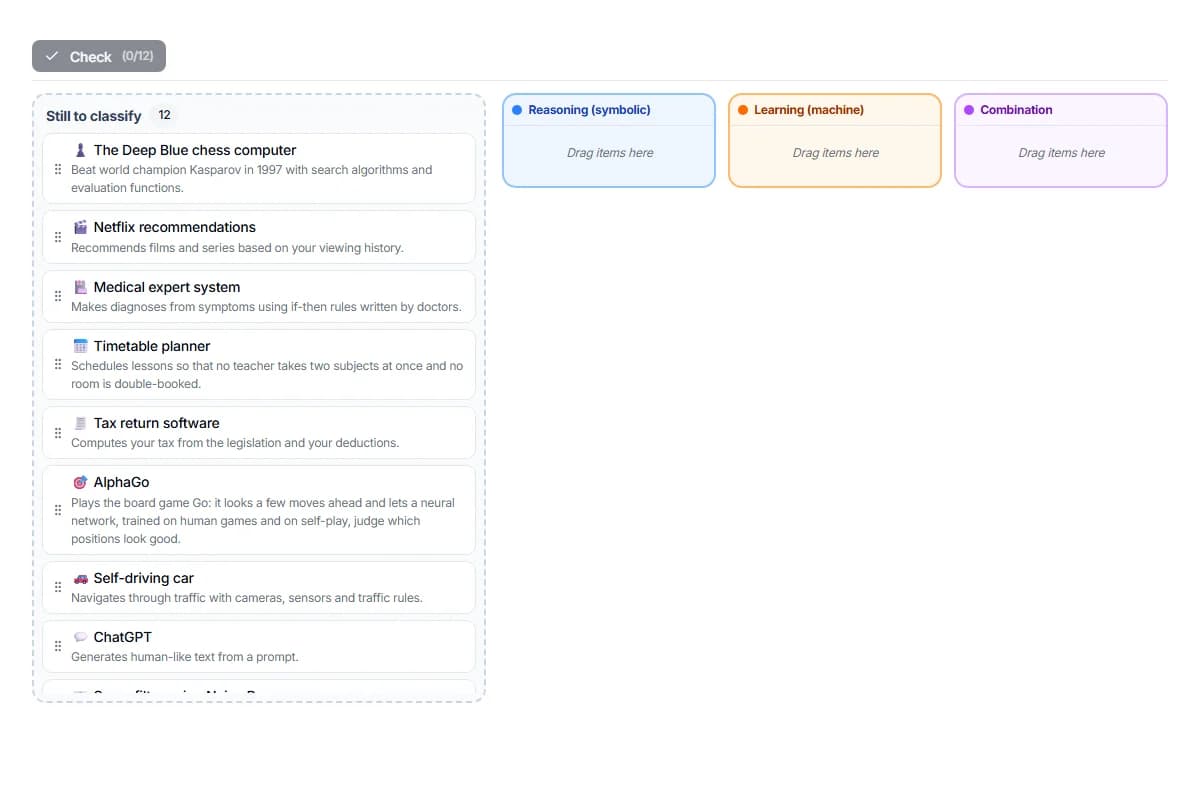
Reasoning fits when the rules already exist (traffic rules, tax laws), when the system has to explain why, or when it must never do anything dangerous. Learning fits when you cannot write the rules down (how do you recognize this face?) but do have plenty of examples, or when the system has to adapt, for instance to spammers who keep coming up with new tricks. Often you combine both: a self-driving car learns whether the traffic light is red, and reasons that it then has to stop.
Sort the systems below: reasoning, learning, or a combination of the two?
🔁 Forms of feedback in machine learning
What a learning system looks for is a function (external link): a fixed rule that turns input into a usable answer, such as a photo into "cat" or an email into "spam".
A function is a fixed rule that gives exactly one output for every input. You usually write it as , where is the input and the output that goes with it. So always gives 6 for input 3, and always 20 for input 10.
Compare it with a vending machine: press button A and you always get the same drink. If that same button gives cola one time and water the next, it is no longer a function.
The input does not have to be a number, by the way: in machine learning is often a photo, an email or a row from a table, and is for example the label "cat" or "spam".
The three forms of machine learning differ in the feedback the algorithm gets while it looks for that function:
- Supervised learning is learning "with a teacher": every example has the right answer attached, such as a photo with the label "cat".
- Unsupervised learning is learning "without a teacher": there are only examples, and the system has to discover structure in them by itself, such as groups that resemble each other.
- Reinforcement learning (RL) is learning by trial and error, the way you learned to ride a bike: nobody says what is right, but afterwards comes a reward if things ended well and a punishment if they ended badly.
Take a computer that learns to play tic-tac-toe (external link): the players take turns putting down an O or an X, and whoever first has three in a row wins. Pick a form of feedback below and see what the computer gets to see:
What the system gets to see
With every position, the system gets the right answer: the move a good player chose. This way it learns quickly from people, but it rarely gets better than its examples.
AlphaGo from the previous chapter combined the first and the third form: first it learned from human games, then it improved itself by playing against itself.
🧑🏫 Supervised learning
Supervised learning is like learning from a teacher who gives you a whole series of example questions, each with the right answer attached. Together those examples are called the training set, and the right answer with each example the label. The system looks for a function that gives the right label for as many examples as possible.
✍️ Learning a function
Mathematically, a training set with examples is a set of pairs : each time an input with the known answer (the label). That input is typically more than one number: a row from a table is a vector (one number per column), a photo a matrix of pixel values, and an email you first convert into a vector, for instance with how often each word occurs. In the notation it simply stays .
Training then means: find a function such that for as many examples as possible. The loss function measures how far lies from , and training makes the sum of those losses over all the examples as small as possible.
The symbol means "is approximately equal to": the two sides lie close to each other, but are not necessarily exactly equal. So is a prediction that approximates the known answer .
🔢 Classification versus regression
Supervised learning comes in two flavors.
- Classification chooses from a fixed list of possibilities: is this email spam, which digit is in this image, is this tumor benign or malignant?
- Regression predicts a number on a scale: the price of a house, tomorrow's temperature, or the rent in the student room demo from the previous chapter.
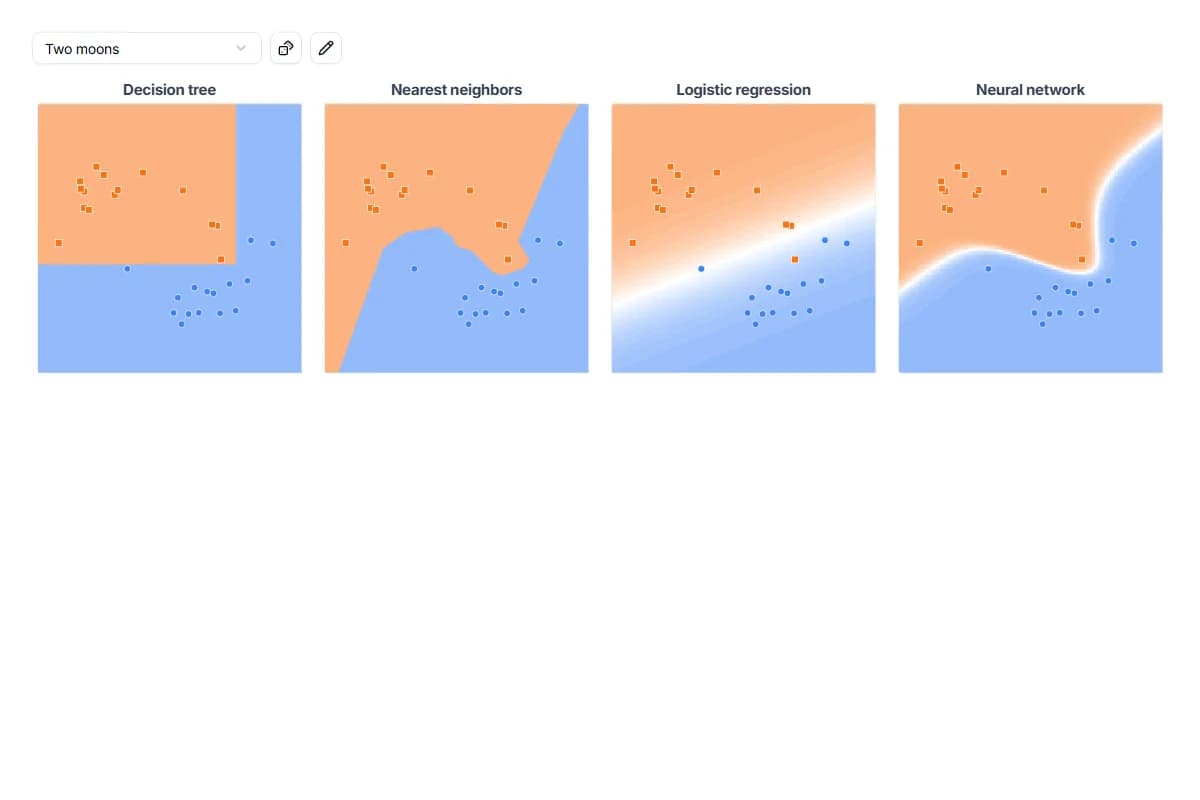
A classification system learns a decision boundary: the line where the prediction switches from one answer to the other. Below, four algorithms that come up later in the course each learned their own boundary between the blue and the orange points. Drag, add or remove points with the buttons at the top, and see how each boundary moves along.
🏷️ Where do the labels come from?
That labeling or annotating is expensive: somebody has to put the right answer with every example. Think of a radiologist who has to mark thousands of scans.
Sometimes, happily, the answers are already in the data itself. Say you want to train a system that predicts the next words in a sentence. Cover up the next word of a sentence, and you have a question (the start of the sentence) with the right answer attached (the covered word that comes after that first part).
- question: the start of the sentence
- answer: the next word
- Question: Leuven. Answer: is.
- Question: Leuven is. Answer: a.
- Question: Leuven is a. Answer: city.
- Question: Leuven is a city. Answer: full.
- Question: Leuven is a city full. Answer: of.
- Question: Leuven is a city full of. Answer: students.
7 words, 6 training examples, and nobody had to label anything.
That is called self-supervised learning. It is how language models such as ChatGPT learned most of what they can do, from the text of a large part of the internet. Image generators do something similar with images: they learn to remove the noise that was added to real photos during training. And if there simply are no answers, you need unsupervised learning.
🧩 Unsupervised learning
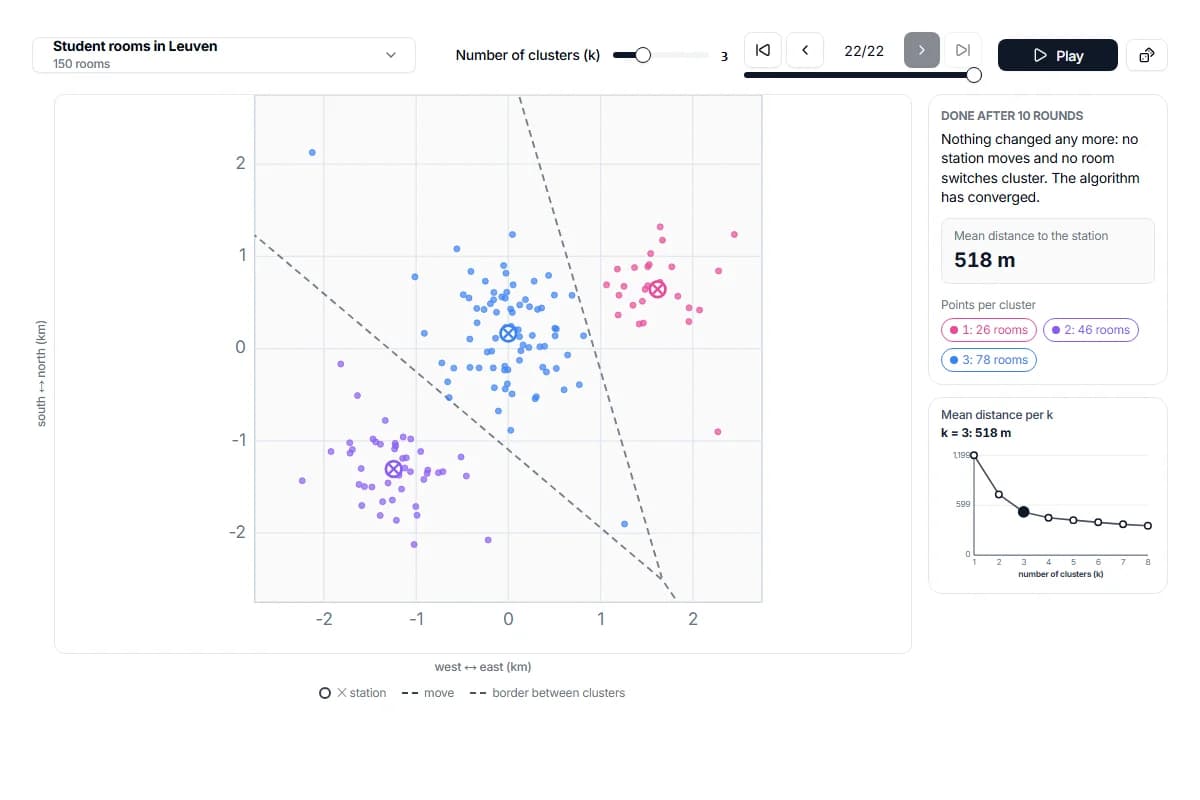
The best-known form of unsupervised learning is clustering: putting items that resemble each other together in groups, the clusters. Choose the number of clusters below and click Play: the algorithm finds groups of points that lie close together by itself.
That is how a music service can recommend songs to you: what listeners in "your cluster" like to hear and you do not know yet gets suggested to you (more about this in clustering).
🎮 Reinforcement learning
A system that learns in the following way is a reinforcement learning agent: it perceives its environment, takes an action and perceives again, gets a reward after its actions, and learns from that which actions pay off.
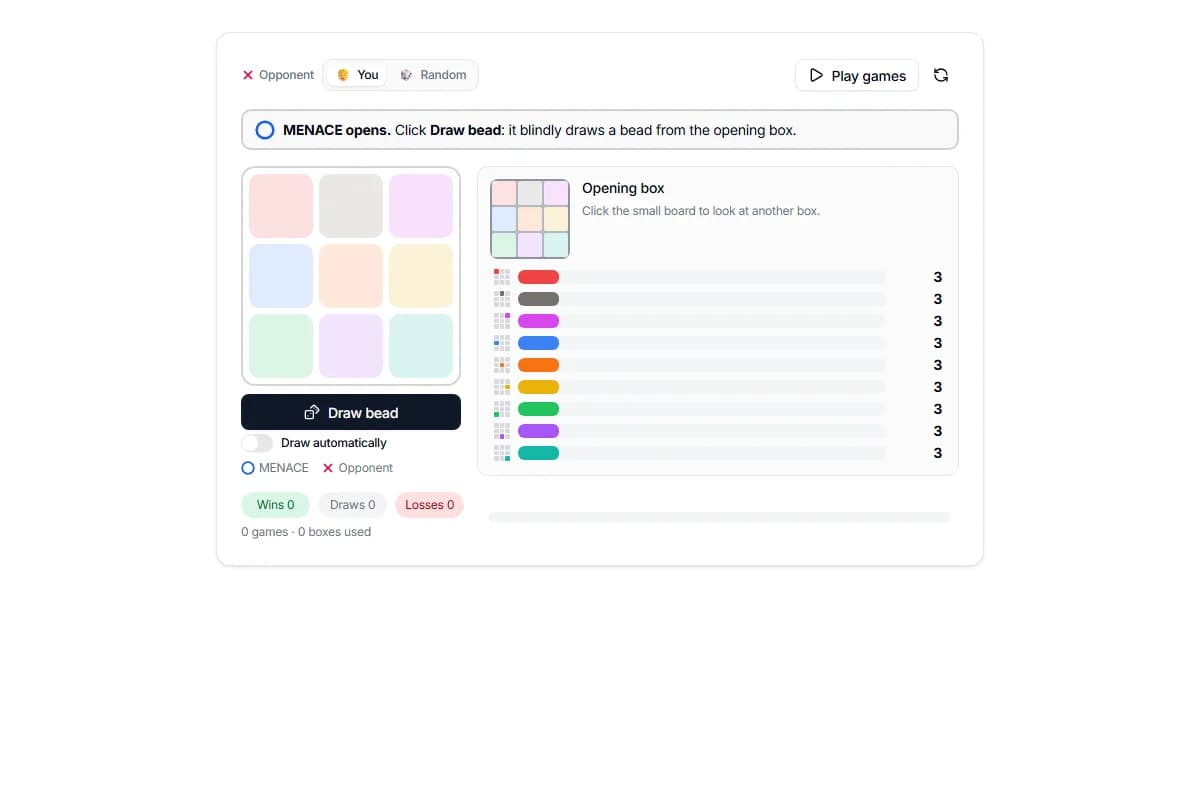
One of the first systems that learned this way did not even need a computer. In the early 1960s, Donald Michie (external link) built MENACE (external link): 304 matchboxes full of colored beads that together learned to play tic-tac-toe. This is how it works:
- State: Every matchbox belongs to one position of the board in which it is MENACE's turn.
- Action: Every bead color stands for an empty square where MENACE can play. MENACE draws a bead blindly from the box of the current position: the more beads of a color, the greater the chance of that move.
- Reward: After the game comes the reward: on a win, every box used gets three extra beads of the color drawn, on a draw one, and on a loss the bead drawn disappears.
- Strategy: That way MENACE gradually learns which move to pick in each position.
So MENACE rewards all the moves of a game it won, the weaker ones included, but over hundreds of games that evens out.
Try it out:
- Click Draw bead: MENACE draws a bead from the box of this position and puts down its O. Then click an empty square yourself, and play the game out like that.
- After the game you see for every box used which bead was added or removed (+3, +1 or −1), and how the chance of that move rose or fell as a result. Click Next game and play a few more.
- Click Play games: MENACE plays game after game against a random opponent, faster and faster. Watch the bars in the opening box shift towards the moves that won. Click the small board above the box to draw a position yourself and look inside that box.
- After half a minute, set the opponent back to "You" and play against MENACE yourself: it has become a stronger opponent by now. Can you still win? Turn on Draw automatically, so you do not have to click Draw bead every time.
Modern systems work on the same principle, with neural networks instead of beads. That is how AlphaZero (external link) learned Go, chess and shogi (Japanese chess) purely by playing against itself.
🤷 Which kind of learning?
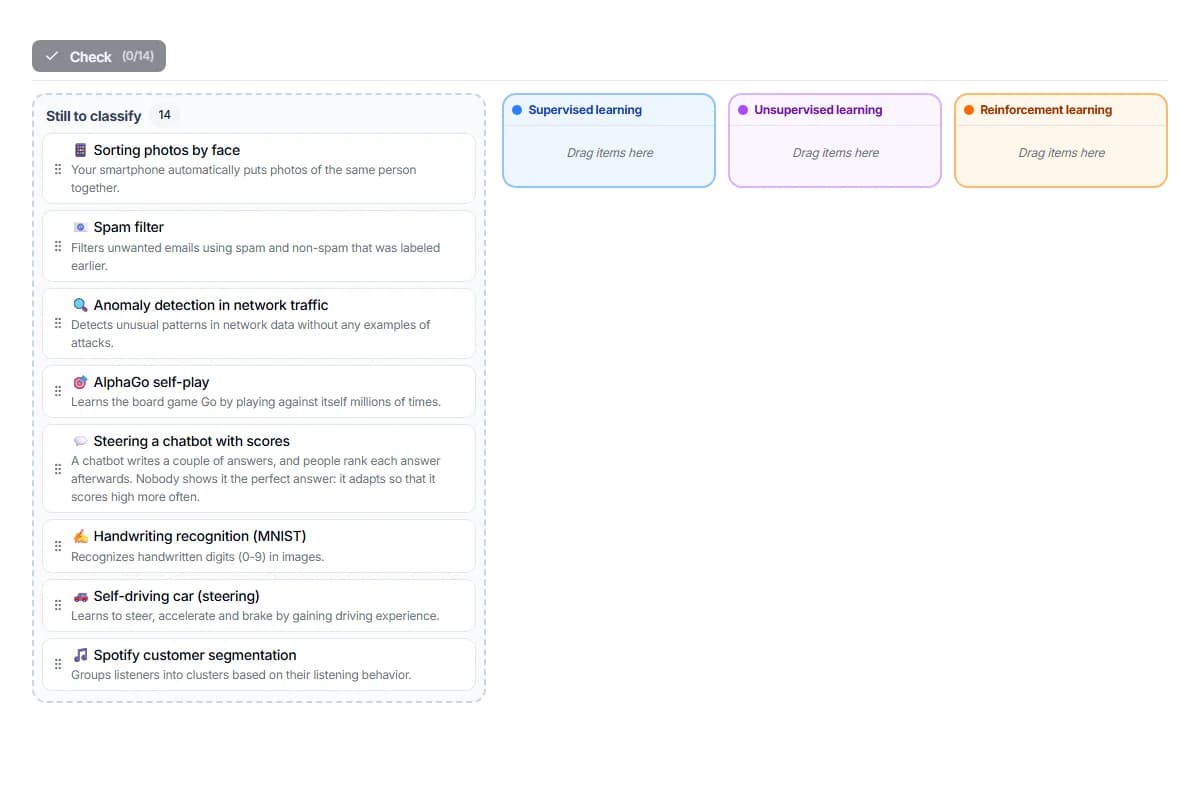
Now test your knowledge: which form of machine learning fits each of these applications?
🏫 Mechanism: five schools of machine learning
Within machine learning, too, there are different ways of going about learning. In his book The Master Algorithm (external link), Pedro Domingos describes five "tribes", or schools, of machine learning, each with its own idea of what learning is:
- ♟️ the symbolists learn rules;
- 🔌 the connectionists learn the weights of a network of neurons;
- 🪞 the analogizers look for what is most similar;
- 🎲 the Bayesians calculate with probabilities;
- 🧬 the evolutionaries let solutions evolve.
You already know three of them from the families of AI, and four get a chapter of their own later: decision trees, neural networks, nearest neighbors and naive Bayes. Here we set all five of them loose on the same small example.
🍽️ Our example table: a meal at the Alma
You are sitting with a few friends in the Alma, KU Leuven's student restaurant, and an unknown person comes to sit with you: a fellow student or a researcher? You only see what is on their tray, but for eight other people at your table you already know. Such a collection of examples is called a dataset. In the table below every person is a row, with what is on their tray (in color) and whether that person is a 🎓 student or a 🔬 researcher.
| Name | 🥖 Bread roll | 🍲 Soup | 🍎 Fruit | 🥣 Yogurt | Student or researcher? |
|---|---|---|---|---|---|
| Anke | yes | no | no | yes | student |
| Bart | yes | no | yes | no | student |
| Caro | yes | yes | no | no | student |
| Dirk | no | yes | yes | no | researcher |
| Evy | no | yes | no | yes | researcher |
| Floor | yes | yes | yes | no | researcher |
| Gert | no | no | yes | yes | student |
| Hanne | no | yes | yes | yes | researcher |
The newcomer has a 🥖 bread roll, 🍲 soup and 🥣 yogurt on their tray, but no 🍎 fruit. For each school below you see how it reaches its verdict. Click the newcomer's dishes to change their tray.
♟️ 1. The Symbolists: logic and rules
The symbolists take their inspiration from philosophy and logic: intelligence is applying rules to symbols, as with the reasoning algorithms, but here the algorithm learns the rules from the examples by itself. A decision tree asks one question after another, starting with the question that best separates the groups: do you eat soup? Whoever eats no soup is always a student in our table.
Student: Anke, Bart, Gert
Researcher: Dirk, Evy, Hanne
Researcher: Floor
Student: Caro
❔ newcomerEvery path from top to bottom is a rule that anyone can read back, such as the newcomer's (and Caro's): IF soup AND bread roll AND no fruit, THEN student.
🔌 2. Connectionists: neural networks
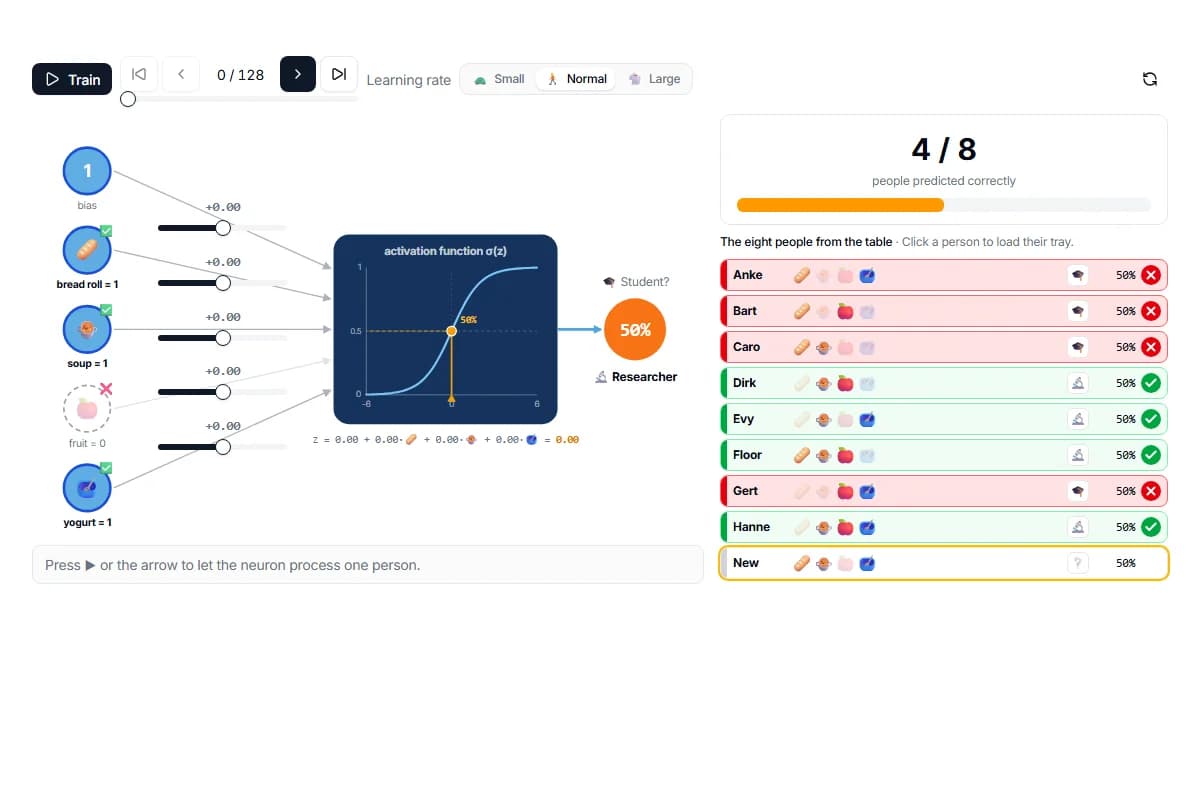
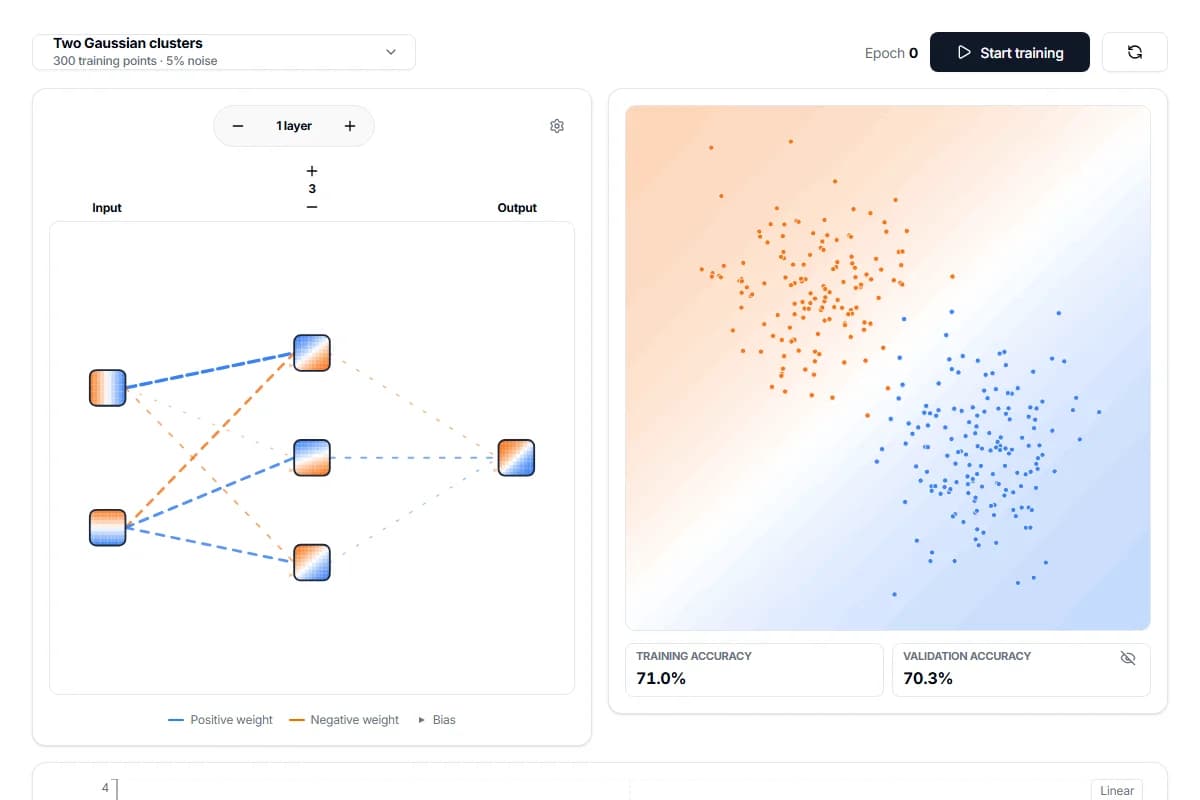
The connectionists take their inspiration from the brain: a network of neurons that learns by adjusting its connections a little after every mistake (more about this in neural networks). A single neuron works like a points tally. Every dish gets a weight: a positive weight pushes towards student, a negative one towards researcher, and a weight around zero does not matter. On top of that comes a fixed starting value (the bias), and the sum of the weights of everything on the tray becomes a probability. During learning the neuron adjusts those weights a little each time, until the students from the table get as high a probability as possible and the researchers as low a one as possible. This is where it ends up:
For the newcomer that gives a 72% probability of student: a bread roll (1.40) points to a student, soup (−1.31) to a researcher, and yogurt (0.32) barely matters. Feel free to move a weight, or click a dish on the left to take it off the tray. With a single neuron you can still read the weights off like this, and so know what each part of the meal contributes to the prediction. In a network of thousands of neurons you no longer can: that is the black box people often bring up with neural networks.
🪞 3. The Analogizers: similarity and distance
The analogizers reason by comparison: this resembles that, so what held for that also holds for this. The simplest example is the nearest neighbor algorithm: find who resembles the newcomer most, and take over their answer. Here we count in how many dishes two trays differ. If several people are equally close, the majority decides:
Framed: different from the newcomer.
The 3 nearest neighbors (they are equally close, so they all vote): 2 × 🎓 student, 1 × 🔬 researcher
Anke, Caro and Evy each differ from the newcomer in just one dish, and two of the three are students. There is nothing to train, and the explanation is immediately clear: "you resemble Anke and Caro, and they are students". With many examples it does become slow, though, because you compare the newcomer with every example.
🎲 4. Bayesians: probability and statistics
The Bayesians calculate with probabilities: they do not answer a hard "yes" or "no", but probably a student, and you can check how that probability was computed. In our example that comes down to counting: how typical is each of the newcomer's choices for each group?
The bread roll and the missing fruit argue for student, the soup for researcher (all the researchers took soup), and the yogurt says nothing. Together that gives a 60% probability of student, a good deal less sure than the neuron: doubt is part of the answer here. Because at heart it is counting, a few examples are enough, and you can easily put prior knowledge into it (there simply are many more students than researchers in the Alma). More about this in probability and naive Bayes.
🧬 5. The Evolutionaries: genetic algorithms
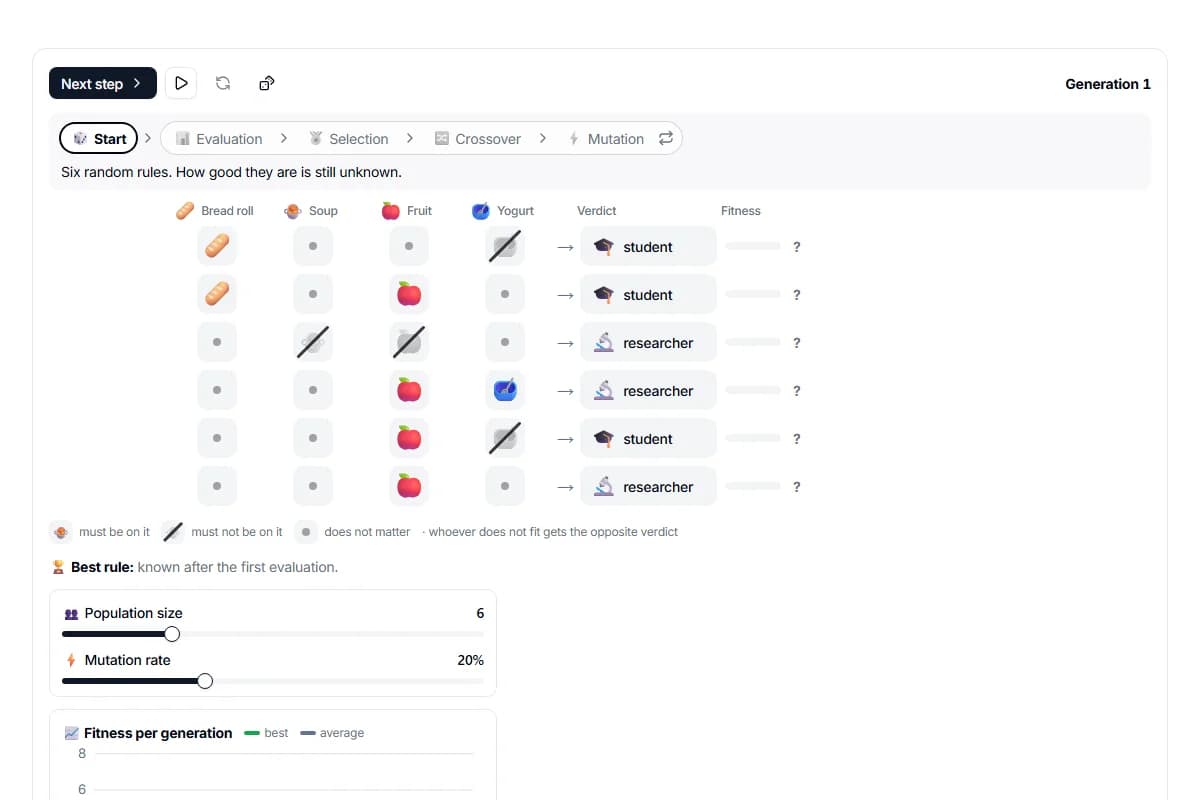
The evolutionaries take their inspiration from natural selection: let a whole lot of possible solutions exist side by side, let the best ones "reproduce", and repeat that for many generations. A solution here is a simple rule, such as whoever takes no bread roll is a researcher; everybody else is a student. How many of the eight people it classifies correctly is its fitness: here 6, because it only goes wrong for Gert and Floor. In the demo below every row is such a rule: a dish in color must be on the tray, a crossed-out dish must not be on it, and with a dot it does not matter.
Try it out:
- Click Next step a few times and follow the five phases at the top: 🎲 start, 📊 evaluation, 🏅 selection, 🔀 crossover and ⚡ mutation. In the crossover you see for each cell which parent it comes from.
- Click a rule to see whom it classifies correctly and whom wrongly, or let the algorithm run on by itself with the play button (▶️).
After three generations the algorithm finds the rule whoever eats no soup is a student here. That rule only gets Caro wrong, and because the newcomer eats soup, the genetic algorithm decides that they are a researcher. Such algorithms sometimes find solutions a human would never think of, but they often need thousands of attempts to get there.
🏆 Which school is the best?
Below are the five verdicts on the same newcomer side by side:
Verdicts: Symbolists: student, Connectionists: student, Analogizers: student, Bayesians: student, Evolutionaries: researcher
Click a school to see how it reaches its verdict.
Four of the five predict student, from 60% sure for the Bayesians to 72% for the neuron. Only the evolutionaries decide otherwise, because their rule looks only at the soup. Change the tray: if you take away the soup, they all agree; if you add fruit, only the neuron still thinks it is a student.
So there is no best school, but there is a best school for your problem:
- symbolists for rules you can read back;
- analogizers when "this resembles that" is already half the answer;
- Bayesians when you also want to know how sure the answer is;
- connectionists for large, messy data such as images, sound and text;
- evolutionaries for solutions you would not think of yourself.
Modern systems often combine several schools.
🎯 Purpose: analyzing vs generating
The five schools all answered the same question: is this person a student? Turn that question around (make up a meal that a student in the Alma would take), and you get a completely different assignment: there is no single right answer, and you have to make something yourself instead of choosing from a list. That difference is the last dimension, the purpose of an AI system:
- 🔍 Analytical AI is the critic: it takes in data and gives one judgment about it, such as a category, a number or a group. It answers the question "what is this?"
- 🎨 Generative AI is the maker: it gets little or even nothing, and makes something new with it, such as text, images, sound or code. It answers the question "what would something like that look like?"
A handy rule of thumb: analytical AI turns a lot of data into a little, generative AI turns a little data into a lot. An image recognizer turns a million pixels into one word ("cat"), an image generator turns five words ("a cat in a spacesuit") into a million pixels.
🔍 Analytical AI: the critic
Just about everything you have seen so far in this chapter was analytical. Such systems come in a few flavors: classification (spam or not?), regression (which rent?), clustering (which customers belong together?) and decision-making (which move, which route?). They do not have to know what the data looks like, only where the boundary lies: a system that tells cats from dogs cannot draw a cat. There is also usually one right answer, so you can simply count how often the system got it right.
🎨 Generative AI: the maker
A generative system does have to know what the data looks like. To make up a plausible student meal, you have to know what students tend to take: three of the four took a 🥖 bread roll, but only one took 🍲 soup. Generating then happens in two steps:
- Learn how likely each possibility is: what does plausible data look like?
- Pick one of them at random, according to those probabilities, as with a die on which the likely outcomes get more faces.
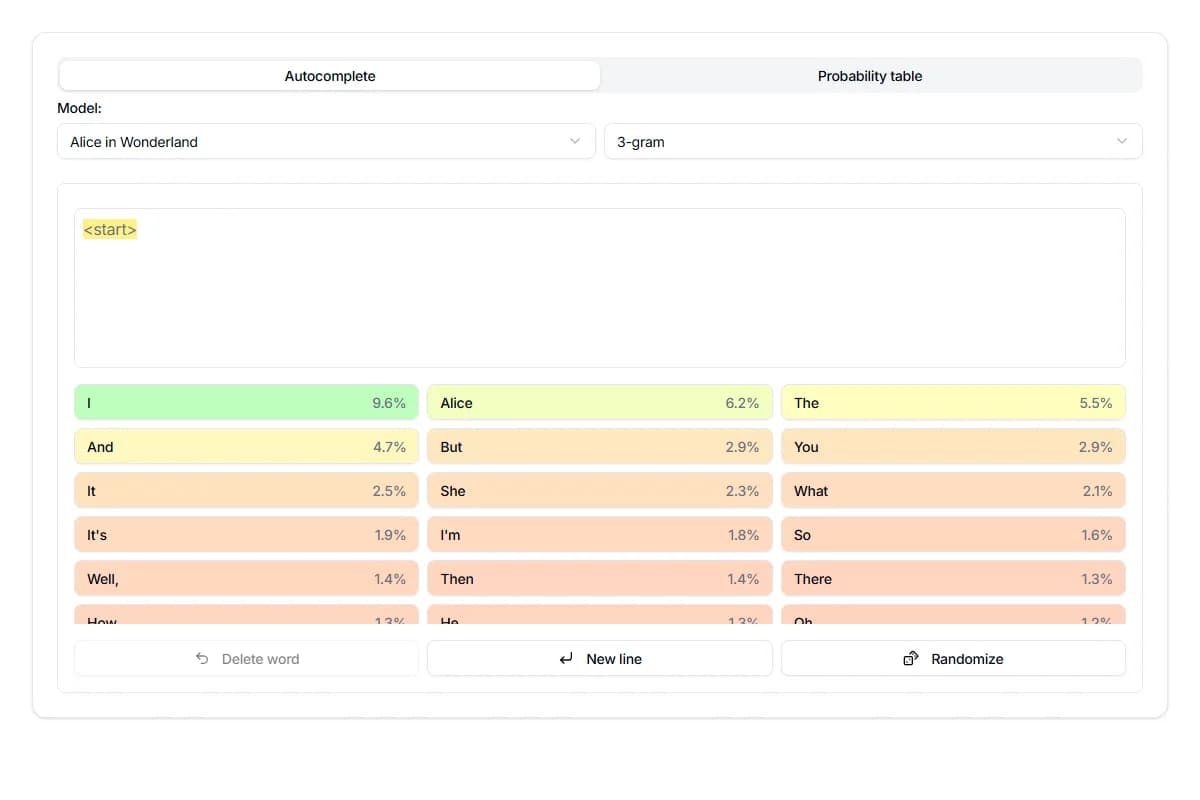
That second step is chance: that is why you get a different answer each time you ask ChatGPT or an image generator the same question. The model below learned one thing from a collection of fairy tales: which words follow each other, and how often.
Try it out:
- Click one of the words, each shown with how likely it is: that way you write a fairy tale yourself, and you are the die from step 2.
- Click 🎲 Randomize: now the computer rolls out the rest of the sentence. Do it again, and you rarely get the same thing.
After a sentence or two the model has lost the thread, because it only looks at the last few words (autocomplete explains how such models work). A large language model such as ChatGPT does the same, but remembers thousands of words of context and learned from a large part of the internet.
⚠️ Why generating is harder
- The system has to invent information that never went in. If the result sounds plausible, it looks right, even when it is made up: a hallucination.
- A long answer is a long series of choices. A text of 300 words means throwing the die 300 times, and one unlucky throw sends everything that comes after it the wrong way.
- There are many valid answers, so you cannot simply count how many were right. Usually people judge, best with two results side by side: which of these two poems is better? Variety counts too: a generator that gives everybody the same neat poem is not a good generator.
🎲 What does the model learn?
Analytical and generative describe the purpose of a system. Mathematically you can also classify the models themselves, by the probability distribution they learn:
- A discriminative model learns directly: the probability of the label given the input . The neuron does that: give it a meal and it gives a 72% probability of student.
- A generative model learns the joint distribution : what does a student's meal look like, and how often do students occur in the first place? From that you can draw new meals.
Out of a generative model you get a classifier for free, via Bayes' theorem: . That is what naive Bayes did above: it counted per group how often each food choice occurred () and weighed that with the prior probability , as a generative model that we put to analytical use.
The other way round it does not work: out of the neuron you cannot generate a single meal, because it only knows where the boundary lies. So a generative model can both analyze and generate, while a discriminative model can only analyze.
🔀 When maker and critic work together
The boundary is not black and white: many systems put both roles to work.
-
🏷️ Generating in order to judge. If you ask ChatGPT whether a review is positive, a maker does a critic's job: it simply generates the word "positive". That works surprisingly well, but it stays generating, with all the uncertainty that brings.
-
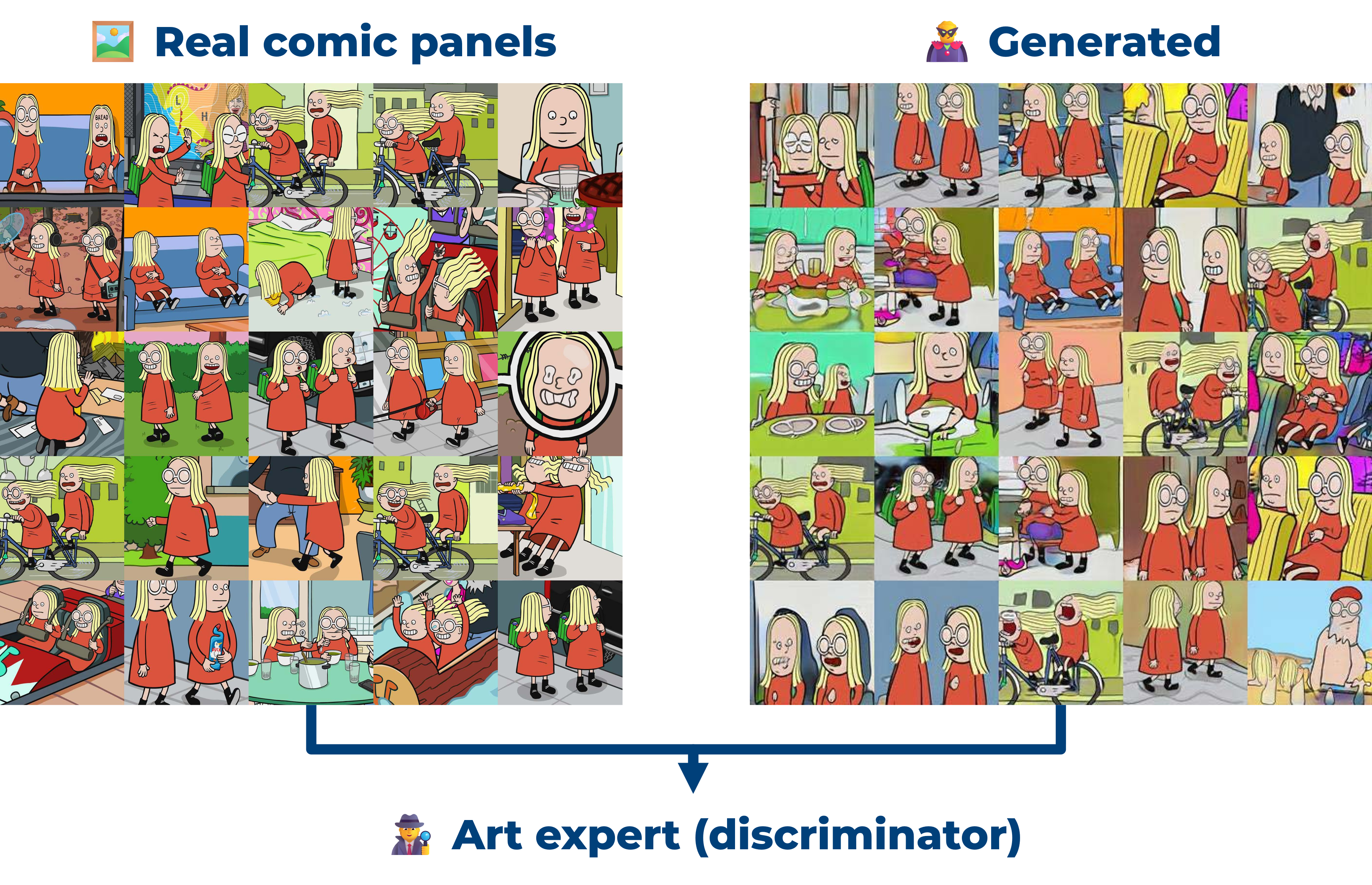
⚔️ Training each other. In a generative adversarial network (GAN) the generator plays the forger: it makes fake paintings. The discriminator plays the art expert: it has to tell real paintings from the dataset apart from those forgeries. Each learns from the other's judgment, until the generator makes paintings that resemble the real ones.
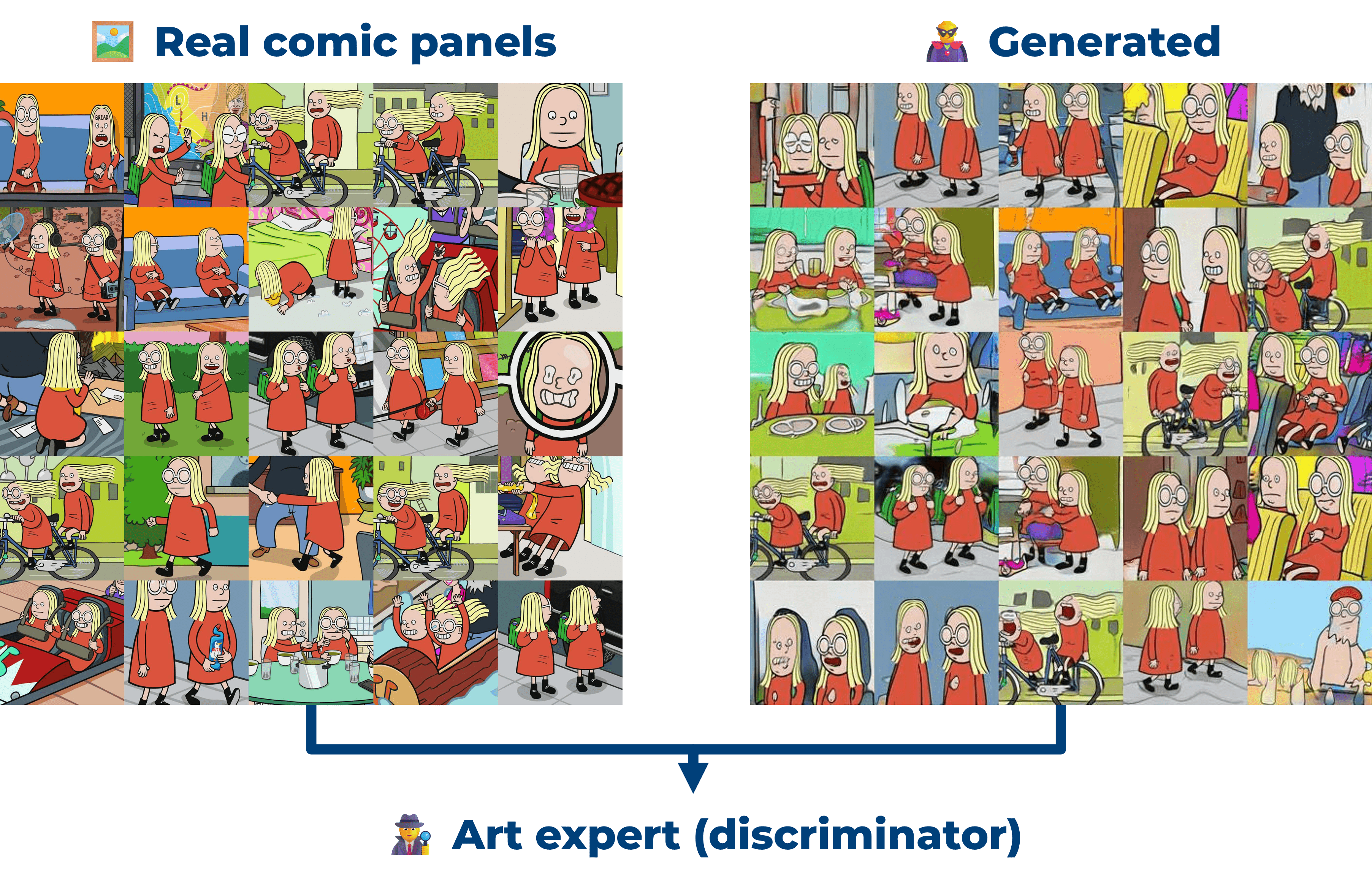
A GAN that learned to generate new comic images, in a project by Marnix Verduyn (external link)
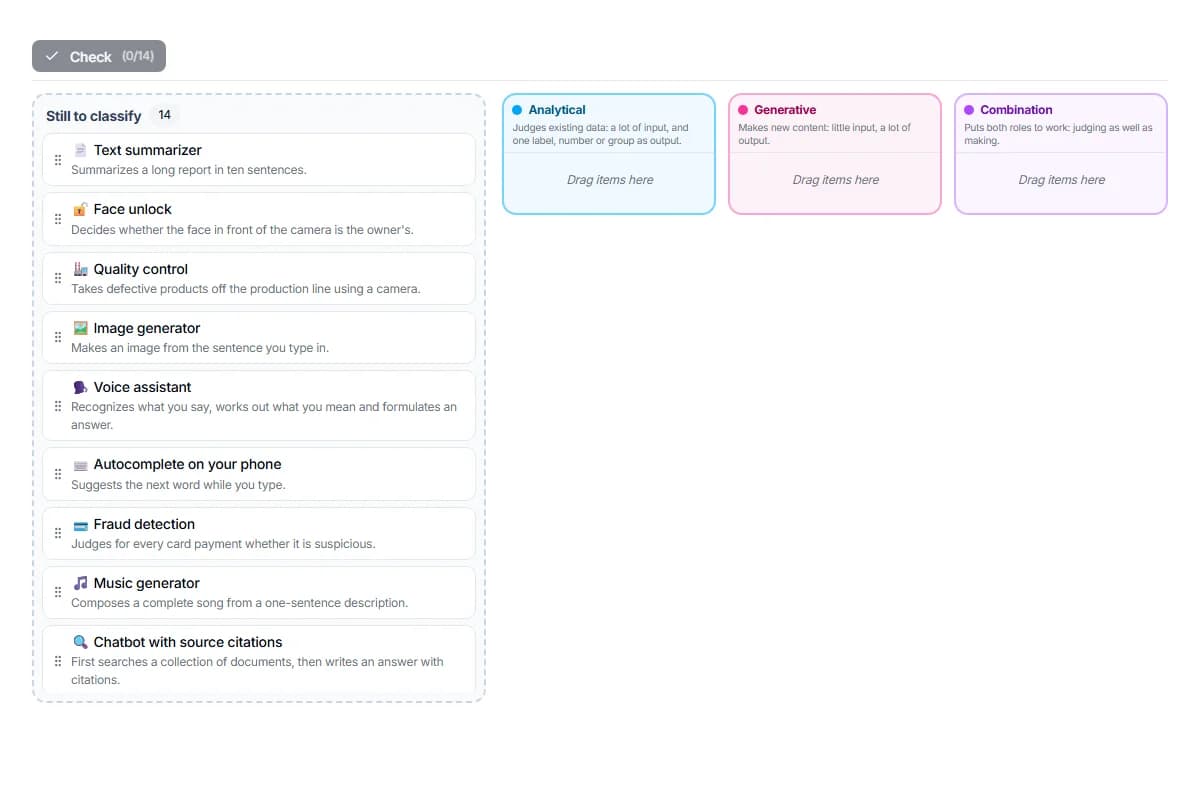
Test yourself: does each of these systems analyze, generate, or do both?
🕹️ Demos
Experiment further with the full simulators and demos featured above.
🗣️ Feedback
Just like machine learning algorithms, we also love learning from your feedback to improve the course.
Let us know how informative and how difficult you found this chapter, and where it could be better.