📜 History of AI
🌍 AI is everywhere
🏠 AI in everyday life
How many different AI systems have you used yourself today? None at all? One? A couple? More than five?
The real number is probably much higher than you think. From the moment you woke up this morning you have been surrounded by artificial intelligence (AI), usually without noticing.
Which of the following have you already used today? Tap the apps on the home screen below to find out which AI is hiding behind them.
0 of 8 apps discovered
Tap an app you have already used today, and find out here which AI is behind it.
AI is everywhere, then. Still, you might well wonder: why does none of this feel like "real" AI?
🎯 The shifting boundary of intelligence
There is something peculiar about the way we think about AI. As soon as a computer can do something we used to consider "intelligent", we stop calling it intelligent. We start seeing that task as "just a computer task" rather than as artificial intelligence. As a society we keep shifting our definition of intelligence that way. The phenomenon is known as the "moving goalpost": the posts marking what counts as intelligence are moved again and again.
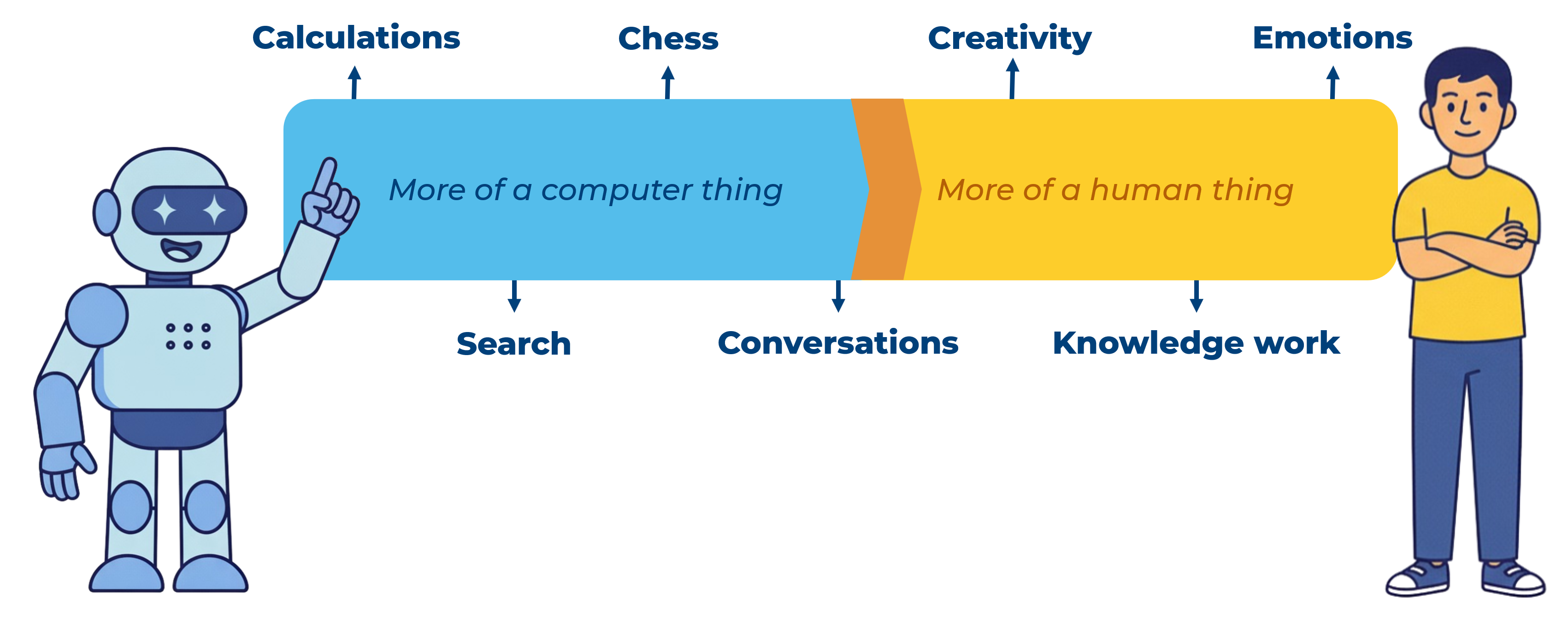
Doing arithmetic, finding search results, playing chess, playing the board game Go, writing fluent prose: every time, the same pattern. As soon as a computer manages it, we stop counting those tasks as "intelligent".
So we keep reconsidering what "real" intelligence is and what sets us, as humans, apart from AI. That constant shift makes it hard to define AI purely in terms of "intelligence". Let us try a different angle.
🤖 What is AI?
📖 Definitions
What sets AI apart from "ordinary" software? The difference lies in the kind of problem you are solving.
- 💻 Standard programming: an "ordinary" computer algorithm follows a fixed recipe that a programmer has written out step by step: the same input always produces the same answer in the same way (think of a calculator, or of sorting a list of names).
- 🤖 Artificial intelligence: AI deals with problems for which such a fixed recipe is hard or impossible to write out by hand: recognizing a photo, holding a conversation, finding a logical proof, picking a good chess move. The system then has to find the right approach itself, either through clever search and reasoning, or by learning patterns from examples.
The boundary is deliberately vague: exactly where AI begins and ends is something researchers have mildly disagreed about for decades. Below we look at three definitions, each approaching AI from a different angle.
1. From human intelligence. A classic definition by AI researcher Marvin Minsky (external link) states:
Artificial Intelligence (AI) is the science of making machines do things that would require intelligence if they were done by humans.
The comparison with human intelligence makes this feel intuitive: when a machine writes a poem, diagnoses a disease or drives a car, that looks intelligent. But the definition has a fundamental problem: it is relative and changes over time, as we just saw with the moving goalpost.
2. From the behavior of the system. A more technical and more stable definition goes:
Artificial Intelligence (AI) is the study of agents that perceive their environment and act rationally on the basis of those perceptions: taking the best possible actions to achieve their goals.
This definition, based on the standard textbook Artificial Intelligence: A Modern Approach (external link), starts from the behavior of the system. It looks at what the system does instead of at how we perceive it, which makes it far less dependent on the spirit of the age. The agent is the AI system itself: it perceives its environment, picks the action that brings it closest to its goal, and changes its environment with that action. Then it perceives again, and so the loop keeps going around.
Try it out: Choose an AI system below and see what the environment, the agent, the perceptions and the actions are for that system. Next round takes you around the loop once more.
Your living room, with furniture, walls, stray socks and dust
Perceptions
Bump sensor, distance sensor, dirt sensor and battery level
Bumped into the sofa
Actions
Driving, turning, vacuuming and heading back to the charging dock
Turn and drive on
Robot vacuum
Goal
A clean floor
So the ingredients of the definition are deliberately broad. An agent can be a robot with a body, but just as easily a program without one. Its environment can be the real world (a living room, traffic), but also a mailbox, a chessboard or a conversation.
3. The legal definition of an AI system. The two previous definitions describe the research field of AI: what researchers study. But what exactly is a concrete AI system? In 2024 the EU AI Act (external link) gave a formal, legal definition of one, in which the ingredients of the previous definition (input, environment, output) are easy to recognize.
"An AI system is a machine-based system that is designed to operate with varying levels of autonomy and that, for explicit or implicit objectives, infers, from the input it receives, how to generate outputs such as predictions, content, recommendations or decisions."
This legal definition is usable in practice: it settles when something counts as an AI system under the law and when it does not, so its boundaries are concrete.
Although it is written in legal language, it describes exactly the same loop as the research-field definition above. You can lay the pieces side by side one to one: the perceptions are simply the input, and the actions are the output. A calculator also receives input and produces output, but a programmer wrote out every step of it; it infers nothing, and therefore falls outside the definition.
🗂️ The families of AI
How, then, does an AI system infer for itself what to do? There is not one technique for that, but a whole collection, which you can roughly divide into three families:
- 💭 Symbolic AI reasons with symbols and rules written out by people, such as a route planner searching the street map.
- 📊 Statistical models compute with probabilities instead of hard yes/no rules, such as a spam filter estimating how likely an email is to be spam.
- 🧠 Neural networks learn patterns from huge numbers of examples, with layers of simple computing units, such as the language model behind ChatGPT.
The last two families fall under machine learning: they learn from examples by themselves, instead of from rules that someone wrote out. On the map below, each family lists the chapters of this course that deal with it, so you can see where each chapter fits into the bigger picture.
The three families did not appear at the same time: in the history further on, you will see how they followed one another in waves.
🎓 Machine Learning
Machine learning (ML) is the most prominent branch of AI today. Instead of writing out yourself how the computer should carry out a task, you give it examples and let it discover the rules on its own.
🖥️ The difference from traditional programming
In traditional programming you give the computer your input together with the program rules you want to apply to that input, and it works out the answers. Machine learning turns this around: you give the computer examples of inputs together with the right answers, and it learns the program rules itself. Such learned program rules are what we call a model. With such a model the system can afterwards also give an answer for new input that it has never seen before.
Try it out: Click Machine learning below and watch which two cards swap places. Using the model shows what happens with the learned rules afterwards. Try another example too: the pattern stays the same.
You give
You get
A student room of 20 m²
rent = €400 + €10 × floor area
Written by a programmer
€600
Computer
runs the rules
So for the room rent, a programmer makes up the numbers in the rule (€400 and €10 per m²), hoping they are right. Machine learning finds the numbers that fit best for rooms whose rent you already know.
Below you can watch that happen on real rents for student rooms in Leuven. Every black dot is one room: the further to the right, the bigger it is, and the higher up, the more expensive. The line is the model: for every floor area it gives an estimated rent. The dash at each room shows how far off that estimate is: green is nearly right, red is far off. The model starts completely blank and estimates every room at €0, so at the start everything is red.
Try it out: Click Next step (or let it run by itself with ▶️) and watch the line move towards the rooms bit by bit, while the error dashes get shorter and greener.
So nobody has to come up with the rule under the figure: the algorithm derived both the base amount and the price per m² from the examples by itself. That is exactly what we mean by machine learning.
🔄 The learning process
To find that rule, the algorithm went through three steps, which you can follow in the demo above:
- Guess a model. The model starts from a crude guess in which nothing has been learned yet: a flat line at €0, which puts every rent hundreds of euros too low.
- Measure the error. For every room the algorithm compares the estimated rent with the actual one: those are the dashes. The number under the figure sums them up as one mean error.
- Adjust the model. The algorithm changes the two numbers in the rule a little, so that the dashes get shorter on average. Then it measures again, adjusts again, and so on: every click on Next step is one such round.
As soon as adjusting no longer helps, the learning stops. Even the best line is still well off for a few rooms: a room can be more expensive because it is in the city center or has its own bathroom, and a model that only knows the floor area knows nothing about that.
Machine learning models look for a function that ideally turns every input into the correct answer :
For the student rooms, is the floor area, the actual rent and the line from the demo. Learning then means: adjusting the numbers in so that comes out as close as possible to for all the examples. How to measure that "as close as possible" exactly is something you will see later, in regression.
Many models learn this way, including the neural networks behind ChatGPT: they just adjust billions of numbers instead of two. Those adjustable numbers are called the parameters of a model. Machine learning is therefore a form of automatic programming: the computer writes the program itself, on the basis of the data you supply.
🔑 Why machine learning is needed
For the student rooms you could still have found the rule yourself with some trial and error: it is only two numbers. For many tasks even that is out of reach. Just try writing down how you recognize a cat in a photo. By its pointy ears? To a computer a photo is nothing but a grid of colored dots (pixels), so a long series of numbers, and nowhere in those numbers does it say "ear". On top of that, every cat looks different: a different coat, a different pose, different light.
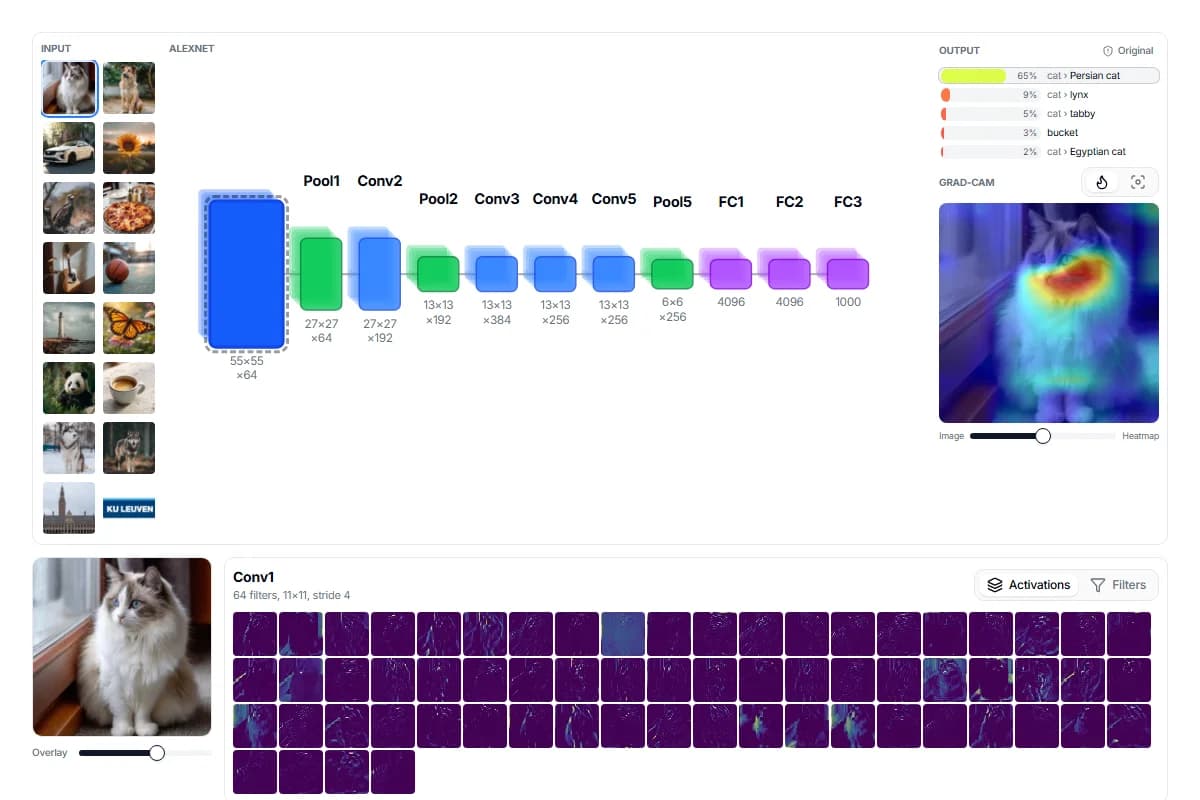
In computer vision (AI that interprets images) you therefore let the computer learn those rules, just as with the student rooms: you show a neural network a huge number of photos, each with the right answer attached, and it discovers by itself which shapes, textures and contours to pay attention to. The network below, AlexNet, learned in this way to recognize a thousand kinds of objects from more than a million photos.
Try it out: Click one of the photos below and look in the top right at the five categories the model considers most likely. Then click one of those five to see what the model paid attention to: red marks the parts of the photo that weigh most heavily for that category, blue the parts that barely count. Does the model look at the same spot as you would?
📜 History
The field of AI is more than 70 years old. In that time, one family after another from the overview above took the spotlight, in three big waves: first symbolic AI, then statistical models and today neural networks. Meanwhile, periods of high expectations, the AI summers, alternated with periods of disappointment, the AI winters.
The timeline below sums it up. The background color shows which family dominated at the time, the curve how high expectations were (a rough estimate, not a measurement), and each pin is an event from this section.
Try it out: Hover over a pin to see what happened then, and click it to read more. Look at the colors of the pins too: some ideas turned up decades before their own wave.
- 💭 Symbolic AI
- 📊 Statistical models
- 🧠 Neural networks
- expectations (rough estimate)
- AI winter
💭 Symbolic AI: the first wave
In the first decades, researchers believed that intelligence could be captured in symbols and rules: write out the knowledge and the reasoning steps for a problem precisely enough, and you get an intelligent system. That produced techniques such as logic, search algorithms, planning (working out a sequence of steps that leads to a goal) and expert systems (programs in which the rules of a human expert have been written out). Think of a GPS looking for the shortest route, a planner that draws up a class timetable without double bookings, or a chess computer that evaluates positions according to pre-programmed rules.
🧪 The Turing test
The roots of AI lie in the 1950s, a time of optimism about what machines might achieve.
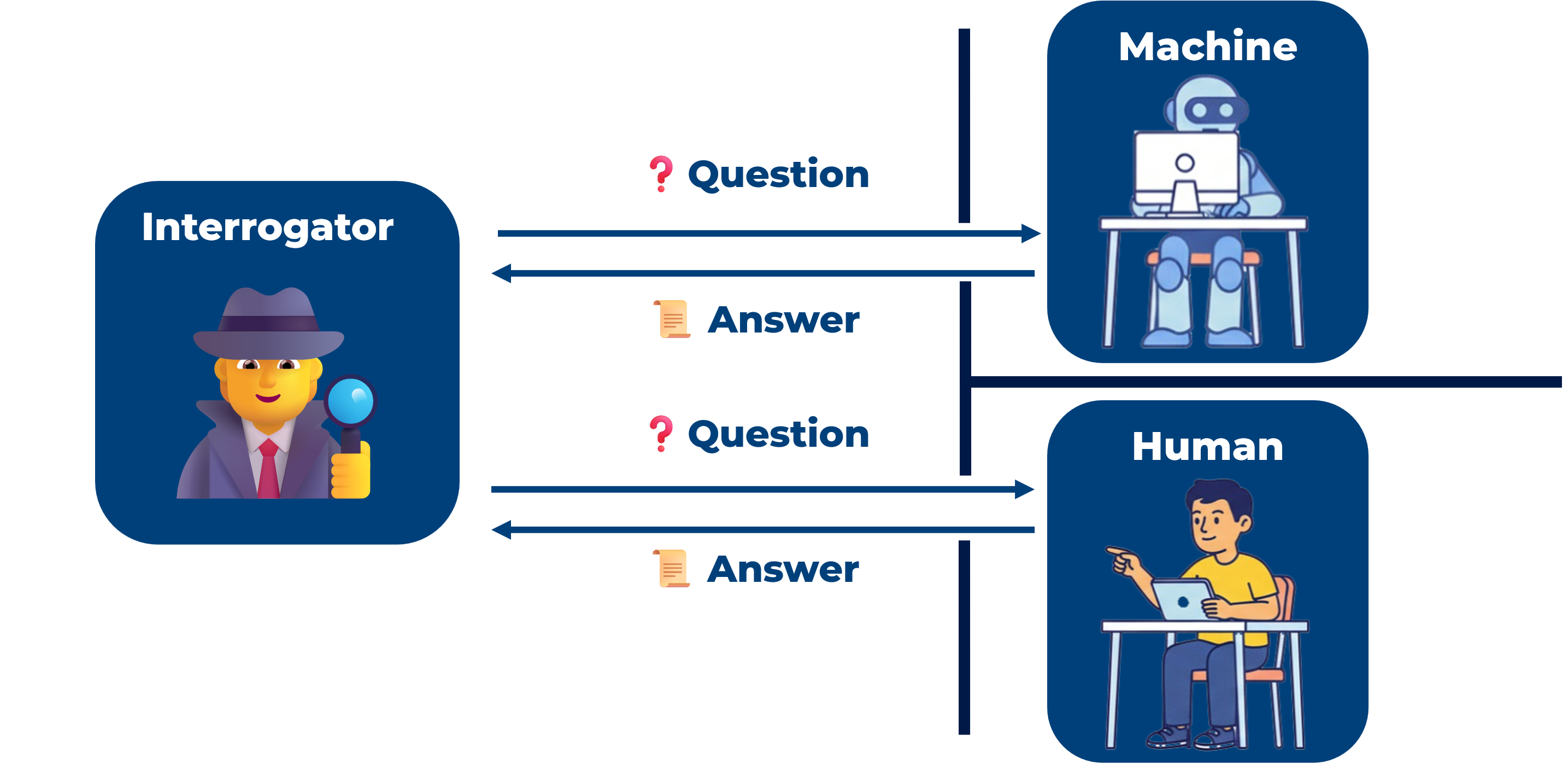
At that time Alan Turing (external link), the father of computing and of AI, asked in a famous paper (external link): "Can machines think?" Because "machine" and "think" are broad words that mean different things to different people, Turing proposed replacing this philosophical question with a practical test. That test is what we now call the Turing test.
In the Turing test an interrogator asks questions in writing, which are passed on from behind a wall either to a machine or to a human being. The machine or the person then answers each question. Because the interrogator neither sees nor hears the respondent, this mainly tests "intelligence" and not how human the machine looks or sounds. You can then measure how "intelligent" a machine comes across by counting how often the interrogator mistakes it for a human.
🏷️ Artificial intelligence as a term
The term "artificial intelligence" is more than seventy years old. It was used for the first time in the proposal (external link) for a summer project at Dartmouth College in the United States. The project was organized by a handful of researchers who really did lay the foundations of many AI techniques. In their proposal they set out the following ambitious hypothesis:
Every aspect of learning or any other feature of intelligence can in principle be so precisely described that a machine can be made to simulate it.
They identified a number of areas of AI research that are still current today, among them neural networks, self-improvement (what we now call machine learning), the use of language, abstraction and even creativity.
🌐 The first translation system
In the same period, researchers demonstrated a translation machine (external link) that could translate more than sixty Russian sentences into English. It knew barely 250 words and parts of words, and six grammar rules. The system treated translation as a kind of deciphering: simple rules, drawn up by people, mapped words onto other words. Although it was limited, this was an early milestone in machine translation: it showed that machines could process language, even if general-purpose translation was still a long way off.
🔬 Perceptron
The first perceptron (external link), an early form of a neural network, was developed in the late 1950s. It was inspired by a mathematical model of brain cells (external link). The perceptron could recognize simple patterns in data, such as telling letters apart. And it did not stay an idea on paper: it was really built as a machine, the Mark I Perceptron (external link), which could "see" images with a camera.
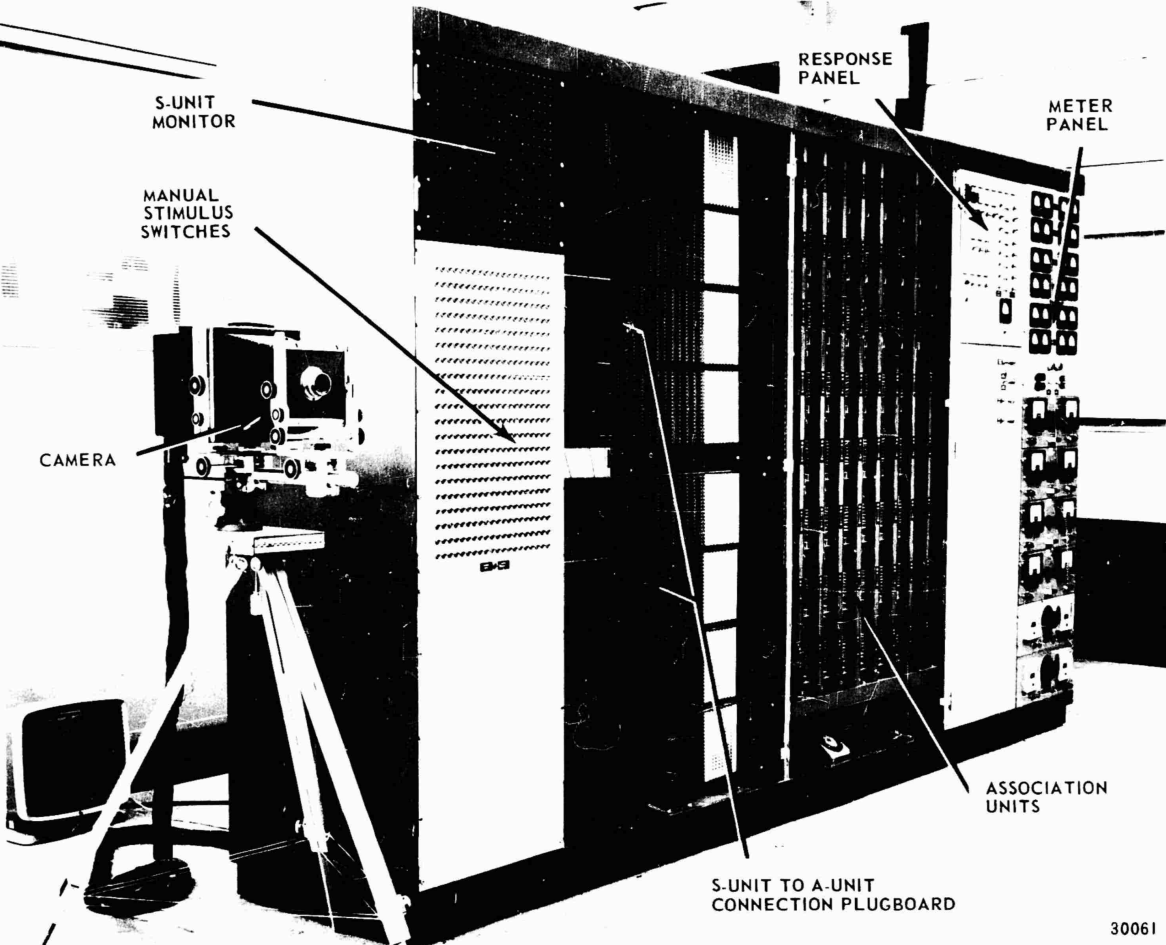
The Mark I Perceptron, the machine that ran the perceptron in hardware: the camera on the left took in the image, a plugboard connected those sensors to the association units, and the response panel showed the answer. Figure from the Mark I Perceptron Operators' Manual (external link) (Hay & Murray, 1960, public domain)
So the idea behind the third wave was there almost from the start, but it would take more than half a century before it really broke through.
💬 ELIZA: the first chatbot
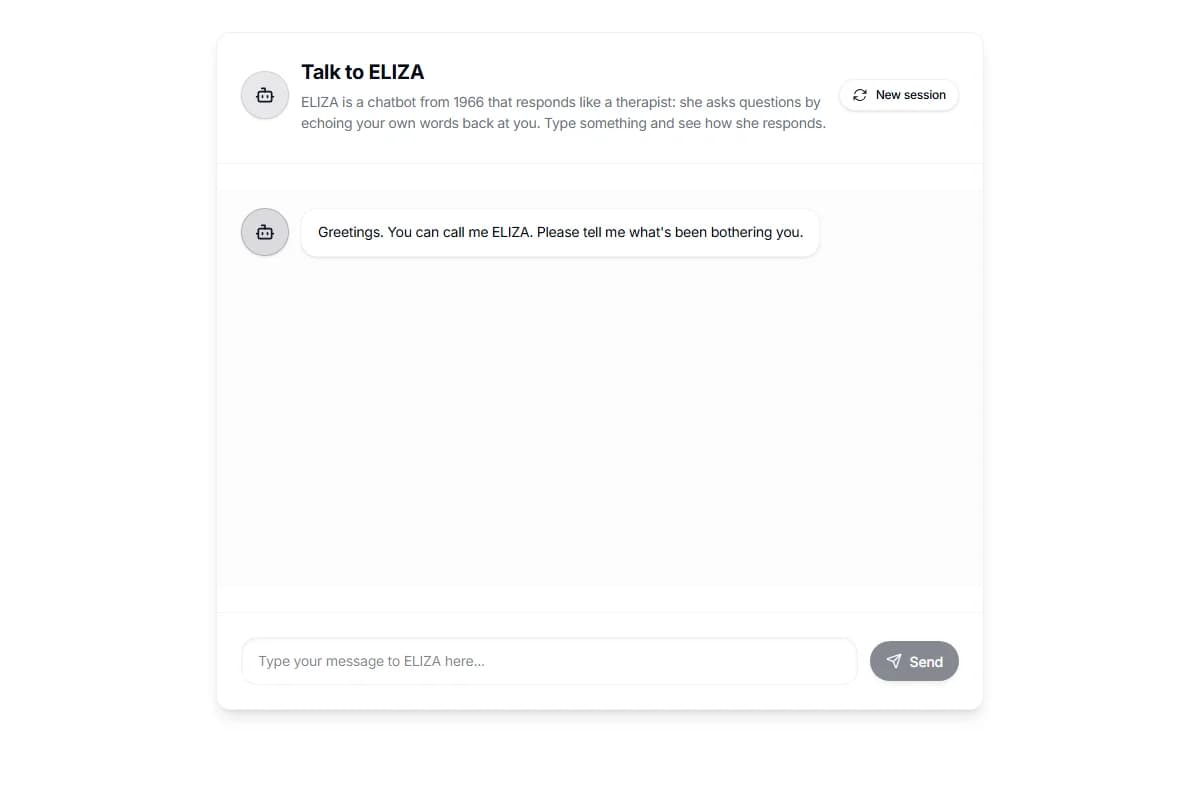
In the mid-1960s Joseph Weizenbaum (external link) developed ELIZA (external link), the world's first chatbot. ELIZA simulated a psychotherapist by asking questions based on whatever the user typed.
Try it out: Type a sentence below and press Send. Start with "I am studying AI", "My friends do not understand me" or simply "no", for instance. Notice how ELIZA bounces your own words back at you as a question, and then see whether you can get the program to give an answer that makes no sense at all.
ELIZA is a simple rule-based system that spots certain words in your message and generates answers by paraphrasing parts of your sentence within fixed patterns. For example:
- Word detection: if you say "no", ELIZA picks a phrase from a fixed list of answers, such as "Are you saying 'no' just to be negative?" or "You are being a bit negative." Say it again and ELIZA simply takes the next one from that list.
- Paraphrasing: if you say "I am a student at KU Leuven", it recognizes the verb "to be" in "am" and reshapes it into a question such as "Is it because you are a student at KU Leuven that you came to me?". This can go wrong, too: say "I am chatting with you" and it may answer "How long have you been chatting with I?", because it always turns "you" into "I".
Weizenbaum showed that surface patterns in language are already enough to make a machine seem intelligent, or even empathetic.
Despite that simplicity, ELIZA left many people feeling that they were talking to a real person. As the story goes, Weizenbaum's secretary asked him to leave the room so that she could be alone during her "therapy session", even after she knew it was a computer program. This was an early demonstration of how quickly people anthropomorphize (external link) machines: attributing human characteristics to non-human entities.
With computers the phenomenon is even named after her: the ELIZA effect (external link), the tendency to ascribe human traits to computers. We still see it today with AI systems such as ChatGPT.
🦾 Shakey the Robot
Around the same time the Shakey the Robot (external link) project began. Shakey was the first robot to combine reasoning with physical action. It perceived its surroundings with computer vision and worked out which actions were needed with planning algorithms. That allowed it to navigate through rooms and carry out simple tasks, such as moving blocks around.
Although it was slow and limited, Shakey laid the groundwork for robotics and for integrated AI systems. The project contributed, among other things, to important search algorithms such as the A* algorithm and to planning ideas whose descendants are widely used in route planning today.
https://www.youtube.com/watch?v=7bsEN8mwUB8
Below, that same A* algorithm looks for the shortest route through the streets of Leuven, as a GPS does.
Try it out: Drag the 🍕 or the 🏠 to another junction on the map. The route is recomputed straight away. Notice that the same two points always give you exactly the same route: the rules are completely fixed and the computer applies them consistently. No data and no learning are involved. That is typical of symbolic AI.
❄️ The first AI winter
By the mid-1970s it had become clear that the early promises were too optimistic. Computers were too slow, memory too limited, and many problems turned out to be exponentially harder than expected. A damning report for the British government (external link) criticized the lack of progress, and governments in the UK and the US cut their funding drastically. This led to the first "AI winter" (external link), which lasted for the rest of the decade: a period in which funding dried up and the research field stagnated.
🩺 Expert systems and the second AI winter
The 1980s saw the rise of expert systems (external link): AI tools that use knowledge within a specific domain (medical diagnosis, say, or configuring computer systems) to carry out tasks at the level of a human expert. Although they were successful at first, they eventually proved too expensive to maintain and too rigid, which contributed to a second AI winter in the late 1980s.
🔁 Backpropagation
Just before that second winter there was nevertheless an important step forward with the rediscovery and popularization of backpropagation: an algorithm for training neural networks efficiently, that is, for taking them through the three steps of the learning process: guess a model, measure the error and adjust the model. The idea was not new, but it only drew wide attention when an influential paper (external link) showed that several layers of neurons could be trained effectively. This opened the way to deeper networks. In practice, though, neural networks stayed small for the time being: the computers of the day were too slow, and there was too little data to train large networks. So backpropagation could not hold off the AI winter, and the real breakthrough only came a quarter of a century later, with the deep learning revolution.
📊 Statistical models: the second wave
In the 1990s, after two winters, attention shifted from written-out rules to probabilities. Statistical models work with the probability that something is true instead of with hard yes/no rules, and so they cope better with the uncertainty you run into everywhere in the real world. What is more, many of those models learn their probabilities from examples by themselves: that is how machine learning gradually became the engine of AI. By then the word "AI" sounded rather suspect, though, so many researchers preferred to speak of machine learning or data analysis. Expectations around AI stayed low, but progress simply carried on.
🎲 Computing with probabilities
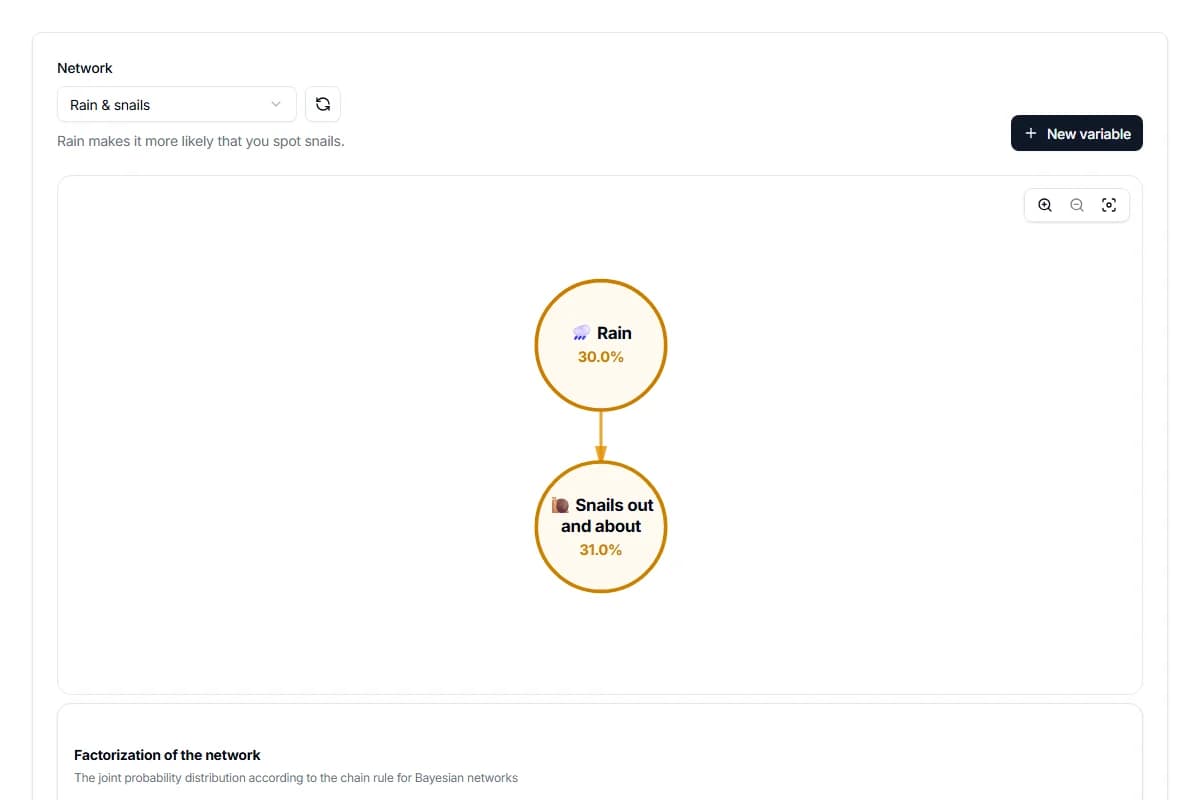
Techniques such as Bayesian networks, which reason with probabilities, and support vector machines, which look for a dividing line between two classes, were successfully put to work in practical applications, such as medical diagnosis. Speech recognition, in turn, relied on Markov models, which predict what comes next from what came just before. Just after the turn of the century, random forests (external link) joined them, combining many small decision trees into one stronger model.
Below is such a Bayesian network for a medical diagnosis. The two circles at the top are symptoms; the one underneath is the condition.
Try it out: Click a symptom and set it to ✅ (present) or ❌ (absent). Watch the probability of flu move along with it: from 8% with no further information to 59% with a fever and a sore throat together. Note what comes out: not a hard "yes" or "no", but a probability. That is typical of this kind of AI model, because it is how they express how certain they are.
♟️ Deep Blue
The best-known AI success of the 1990s did not come from that statistical corner, but from symbolic AI. In 1997 IBM's Deep Blue (external link) beat the reigning world chess champion (external link), showing that machines could outdo humans at intellectual tasks such as chess. To do so, Deep Blue searched a game tree with the minimax algorithm: it calculated moves and countermoves many turns ahead. An evaluation function then estimated how good the positions it reached that way were, using thousands of chess features that people had come up with, such as how many pieces each player has left and how safe the king is. That look-ahead was possible thanks to brute computing power: specially designed chess chips examined some 200 million positions per second.
https://www.youtube.com/watch?v=KF6sLCeBj0s
🧠 Neural networks: the third wave
Neural networks are so-called "connectionist" models: they consist of many simple, interconnected computing units (loosely inspired by the neurons in the brain) that together learn patterns from enormous datasets (large collections of examples, millions of photos for instance). When such a network is built from many layers one after another, we speak of deep learning.
The idea had been around since the perceptron, but only in the 2010s did deep learning really break through. That came down to a combination of factors: the internet generated huge amounts of data; graphics cards (GPU), originally built to give video games better images, turned out to suit the training of neural networks well; and new network architectures (ways of stacking the layers of a network) and training techniques came along. That is how networks first learned to recognize images and play games, and since the transformer they write text as well.
👁️ AlexNet
In 2012 AlexNet (external link) won the ImageNet competition by a wide margin, thanks to deep learning. In that competition an AI model has to decide which of a thousand possible objects is shown in an image. This convolutional neural network, which you already saw at work in the machine learning demo, marked the start of the deep learning revolution. A few years later, models on the ImageNet top-5 test (external link) (a benchmark in which you score a point when the correct category is among your top five predictions) even did better than the human reference score reported at the time on that particular test.
⚫ AlphaGo
Another remarkable result followed in 2016. That year DeepMind's AlphaGo beat one of the best Go players in the world in a match of five games (external link), with moves that commentators described as "creative" and "brilliant". This was special because Go, with its possible positions (more than the square of the number of atoms in the universe), cannot be won by brute force, that is, by simply computing every possible move. AlphaGo had to develop a kind of computational intuition for which board positions were good, just as human players do.
It learned that intuition in two stages. First AlphaGo learned by imitating tens of thousands of games played by strong human players, and then it improved itself by playing millions of games against itself with reinforcement learning.
🔗 The transformer model
In 2017 researchers at Google proposed the transformer architecture in an influential paper (external link). That architecture made it possible to handle sequences (such as text) far more efficiently, a big step for natural language processing (NLP). It allowed language models (models that keep predicting which word logically comes next) to learn from vast amounts of text, such as the whole internet. Such a training phase was often followed by a short second one on a specific language task (classifying reviews as positive or negative, for instance), in which the model could reuse what it had picked up about language in the first phase.
🗣️ ChatGPT
The breakthrough for the general public came at the end of 2022 with the launch of ChatGPT (external link). For the first time, a powerful AI system was within everyone's reach through a simple chat interface. Within five days it had a million users, and after two months a hundred million (external link), which made it the fastest-growing computer application ever at the time.
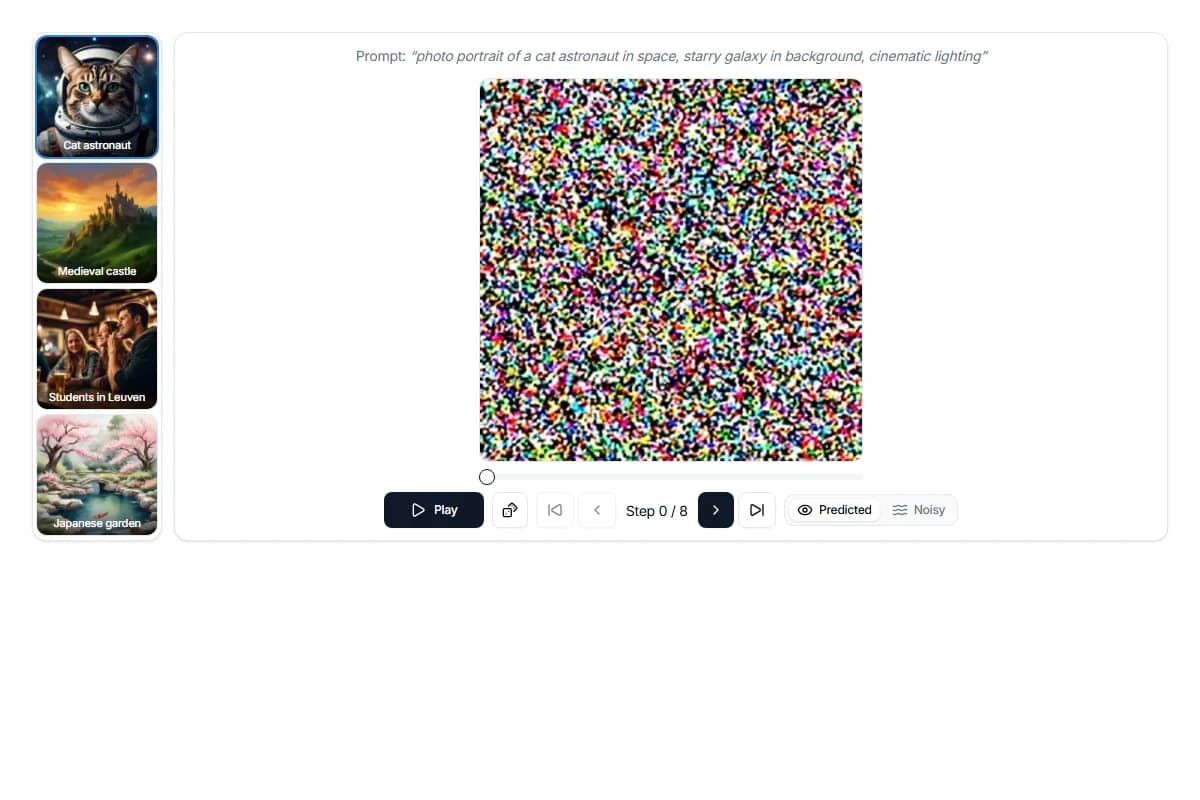
ChatGPT thus became the face of generative AI: AI that produces new text, images or sound itself. That same year, image generators also broke through with the general public: with diffusion models they create an image from a short description.
Try it out: Pick a subject on the left (a castle or the northern lights, say) and press ▶️. The model starts from a field of pure noise and, in a handful of steps, pulls an image out of it bit by bit. Nobody wrote down what a castle or the northern lights look like. The network worked that out from millions of examples.
🤖 From chatbot to agent
After ChatGPT the attention shifted from "a model that answers" to "a model that acts". The key turned out to be tool calling: the model is allowed to call external programs, such as a calculator, a search engine, a program that runs code, or your calendar. The big providers soon built this straight into their models, and the Model Context Protocol (external link) also arrived as an open standard for connecting models to external tools and data sources. Around the same time, reasoning models such as o1 (external link) and DeepSeek-R1 (external link) appeared, which first write out a whole series of intermediate steps before they answer. More intermediate steps also means more moments at which the model can reach for a tool.
The name reasoning model does not refer to the reasoning of the symbolic wave, where a system reasons about symbols with logic and explicit rules. A language model that is a "reasoning model" is still a neural network that learned everything from data: it "reasons" by writing out extra intermediate steps in ordinary text before it answers. Learning and reasoning are not opposites here: the model learned to work step by step.
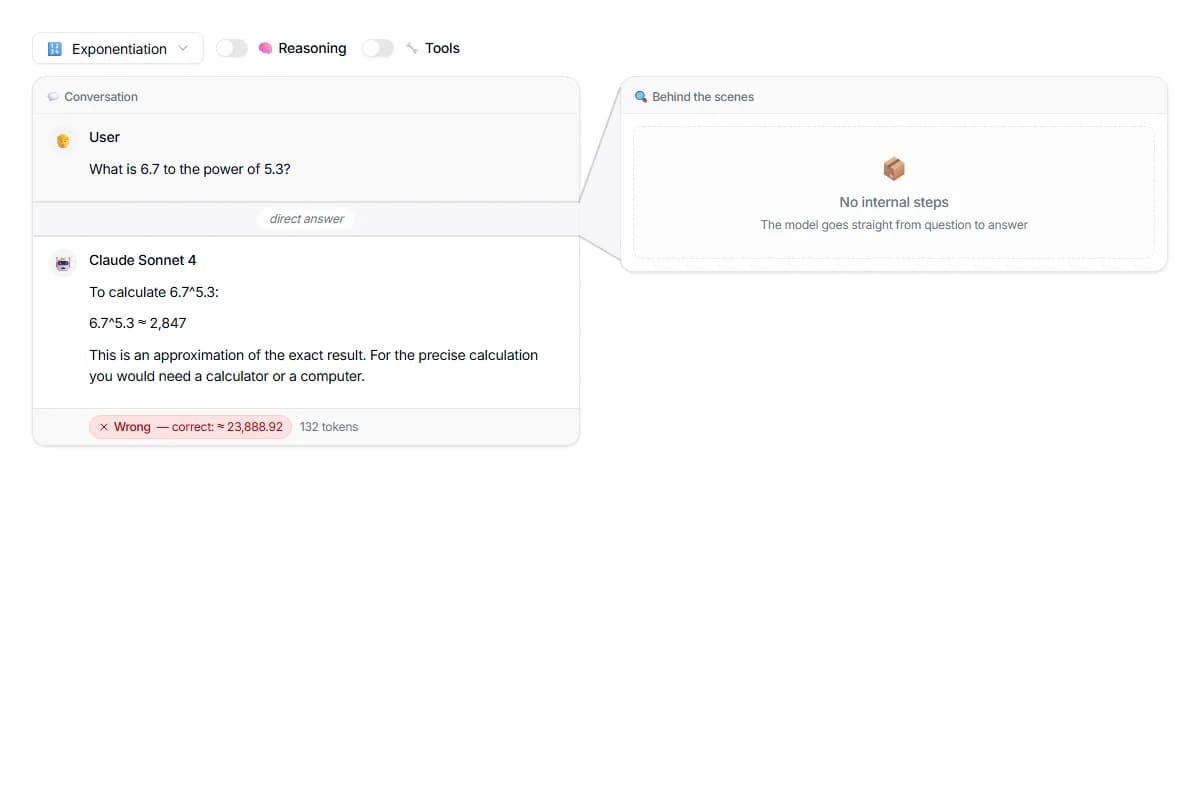
Try it out: Below, someone wants to plan a weekend in Paris, starting from Leuven. Without tools, the language model guesses what a train ticket costs. Switch on 🔧 Tools and look at 🔍 Behind the scenes to see what changes: now the model first looks up the price and has a calculator work out how much of the budget is left. With 🧠 Reasoning switched on as well, you also see the intermediate steps the model writes out first.
This is how the present wave of agentic AI came about: agents that pursue a goal on their own over many steps. Think of a coding assistant that searches through your code, edits files, runs the tests and corrects itself on the basis of the error messages, or of a model that works through a series of web pages to answer your question.
More and more often, moreover, it is not one agent working on your task but a whole "swarm" of agents. A main agent splits the work up and sets subagents to work, each doing a piece of it (one looks up sources, another writes code, a third checks the result), and they report their findings back to the coordinating main agent. That has two advantages: each agent keeps to a smaller assignment with a more manageable working memory, and the subtasks can run at the same time instead of one after another.
Note that this brings us back to the definition this chapter began with: such an agent makes observations (search results, error messages), takes actions (calling tools, writing files) and works towards a goal that way, with a certain degree of autonomy. After seventy years the circle is complete: the rationally acting agent from the definitions of AI is once again the dominant way to build AI systems. How all of this works under the hood is covered in the chapter on agentic language models.
🎢 AI summers, AI winters and the hype cycle
As the timeline shows, the history of AI moves in cycles: a big breakthrough raises inflated expectations (an AI summer), and when those are not met, funding dries up and the field stagnates (an AI winter).
That pattern is not unique to AI. The Gartner hype cycle (external link) describes how expectations around many new technologies develop: after a breakthrough they rise to a peak of inflated expectations, then they sink into a trough of disillusionment, and only then do they slowly climb to a realistic level, at which the technology delivers real value. An AI summer is such a peak, an AI winter such a trough. Careful: the curve describes society's expectations, not the actual value of the technology. Even in a trough, a technology can be useful.
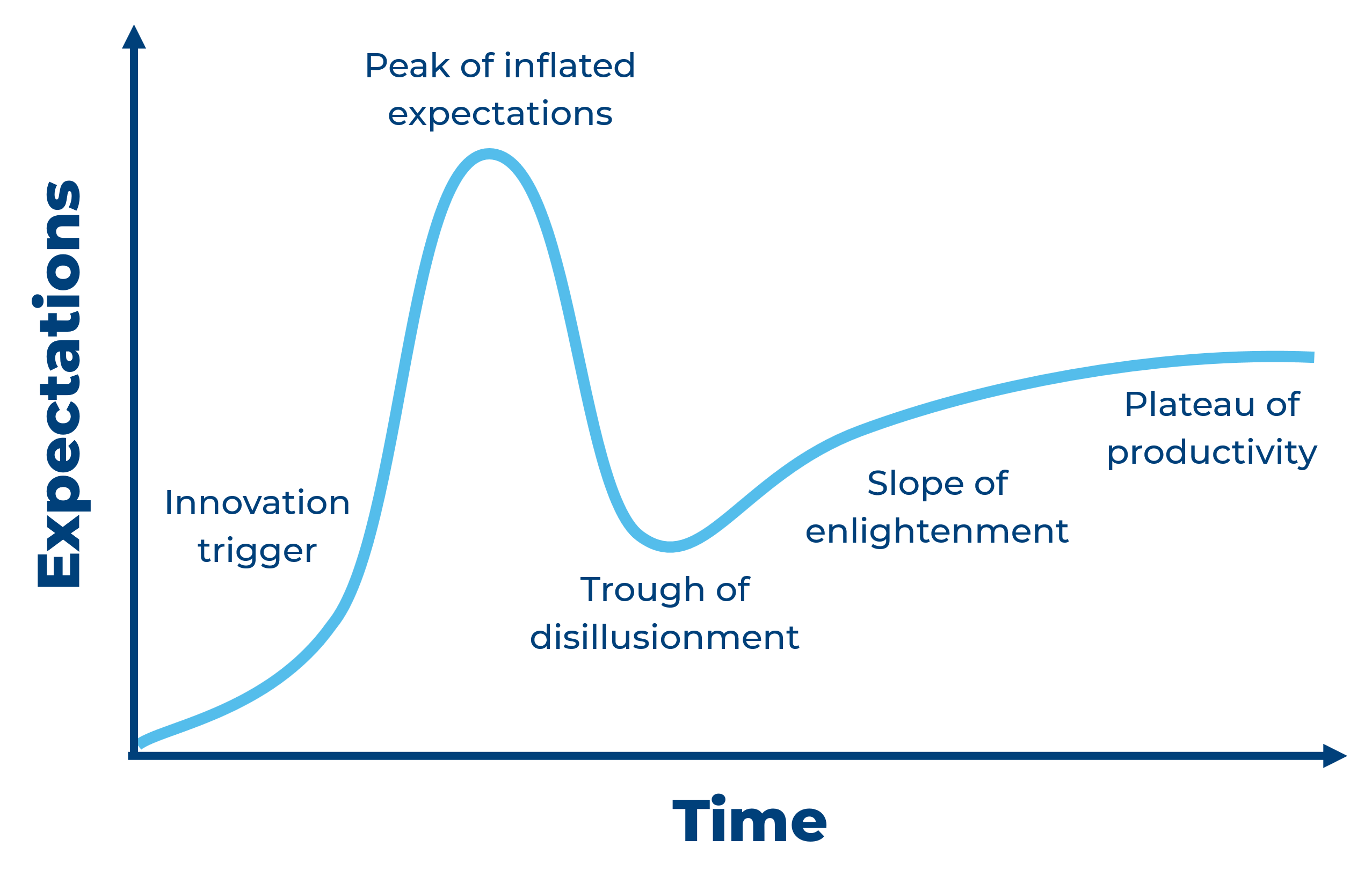
We are currently in the biggest AI summer ever: first around generative AI and by now mostly around the agentic AI above.
If history teaches us anything, such a peak is indeed often followed by a correction. That does not make the technology worthless, though: after the trough, usable applications typically take shape, and with generative AI we are seeing more and more of them. So follow developments in AI with a critical but open mind: neither believing the hype blindly, nor cynically dismissing every advance.
🕹️ Demos
Experiment further with the full simulators and demos featured above.
🗣️ Feedback
Just like machine learning algorithms, we also love learning from your feedback to improve the course.
Let us know how informative and how difficult you found this chapter, and where it could be better.